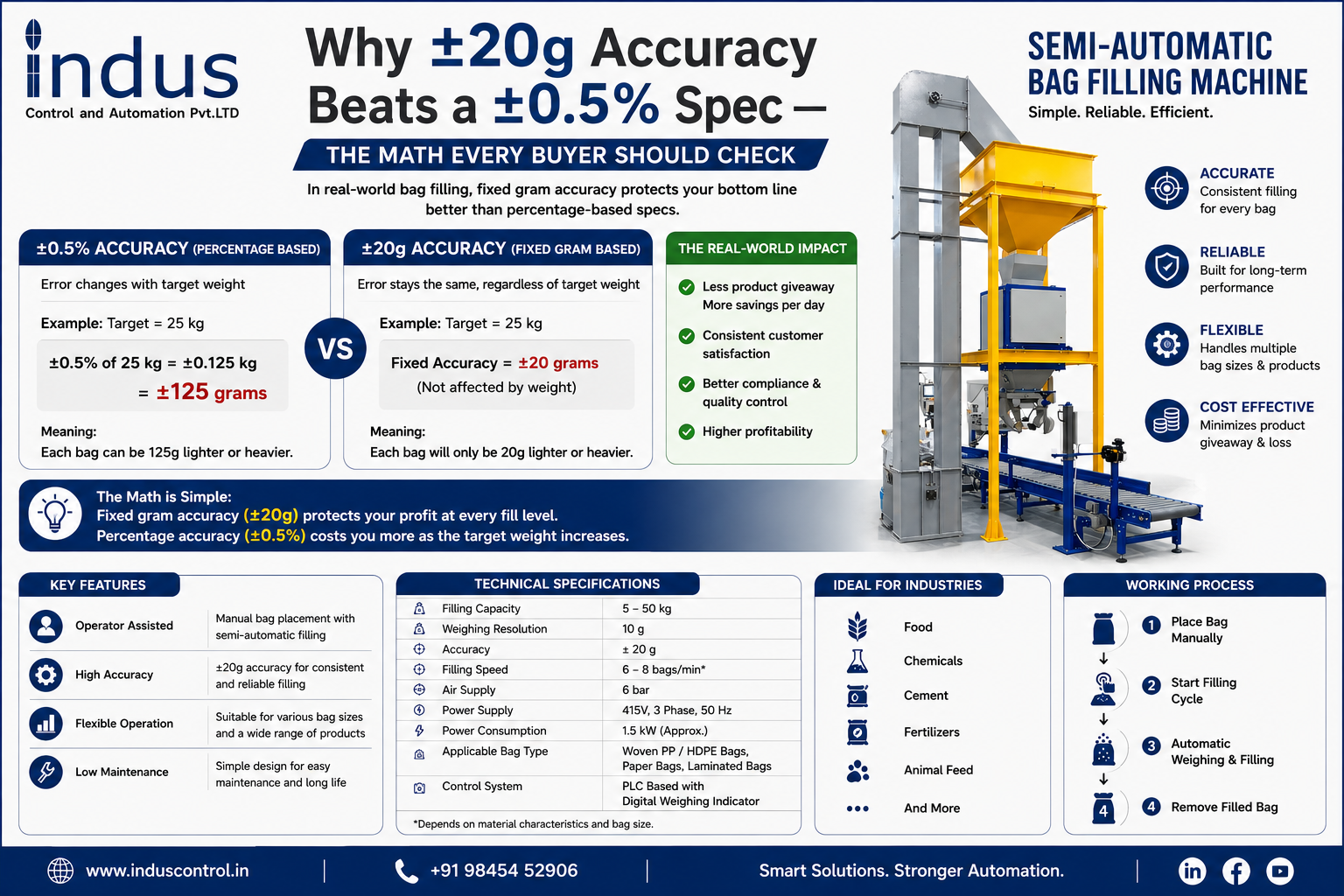
Two bag filling machine spec sheets sit side by side. One says accuracy of ±20 grams. The other says accuracy of ±0.5%. Which one is tighter?
Most buyers can’t answer that question on sight — and that’s not a knock on them. Grams and percentages aren’t the same unit, and comparing them without converting one into the other is like comparing a price in rupees to a price in dollars and assuming the smaller number wins. It’s exactly this confusion that lets a wide, unhelpful accuracy spec sound just as good as a tight one, right up until someone does the math.
This article does that math, in full, for bag filling machine accuracy claims across the 5 kg to 50 kg range most mid-scale packaging lines actually run. It also covers the one spec-sheet trick that matters more than either number — the difference between accuracy and resolution — and how to ask a manufacturer the right question before you buy, not after.
In this guide:
- Why grams and percentage accuracy specs aren’t directly comparable
- The conversion math, explained simply
- The full comparison, worked across every bag weight from 5 kg to 50 kg
- Why resolution isn’t the same thing as accuracy — and how that gets blurred
- What inaccurate weighing actually costs, beyond the spec sheet
- How to verify a manufacturer’s accuracy claim before you order
- What actually determines real-world accuracy
- FAQs
Why Accuracy Specs Are Genuinely Confusing
Manufacturers express bag filling machine accuracy in one of two ways: as an absolute figure in grams (±20g, ±50g), or as a percentage of the target fill weight (±0.2%, ±0.5%). Both are legitimate ways to describe a weighing system’s performance. The problem is that they behave completely differently depending on bag size, and almost nobody converts one into the other before comparing.
An absolute gram spec means the same thing regardless of what you’re filling — ±20g is ±20g whether you’re bagging 5 kg of spice or 50 kg of cement. A percentage spec, by contrast, scales with the bag: ±0.5% is a tiny, tight tolerance on a 5 kg bag and a much looser one on a 50 kg bag. That scaling is exactly why a percentage figure can look impressively consistent across a manufacturer’s whole capacity range while actually representing a very different real-world tolerance at each end of it.
Neither format is inherently dishonest. But side by side, without conversion, they’re not telling you what you think they’re telling you — and that gap is where buyers make expensive assumptions.
The Math: Converting Between Grams and Percentage
The conversion itself is simple, and it’s worth doing every time you compare two quotations:
Percentage → grams: multiply the percentage (as a decimal) by the target bag weight. Example: 0.5% accuracy on a 25 kg bag = 0.005 × 25,000g = 125g of tolerance.
Grams → percentage: divide the gram tolerance by the target bag weight. Example: ±20g accuracy on a 25 kg bag = 20 ÷ 25,000 = 0.0008 = 0.08%.
Run both machines through the same formula at the same bag weight, and you’re finally comparing the same thing. Skip this step, and “±0.5%” simply sounds more precise than “±20g” to anyone scanning a spec sheet quickly — even in cases where it isn’t.
The Real Comparison: ±20g vs. ±0.2%–0.5% Across the Capacity Range
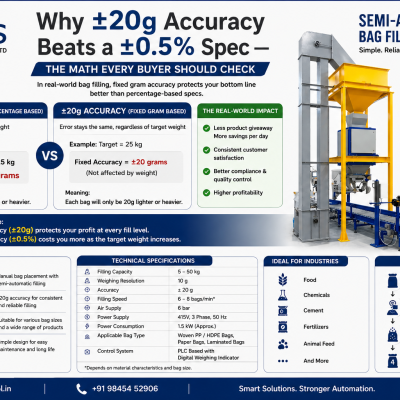
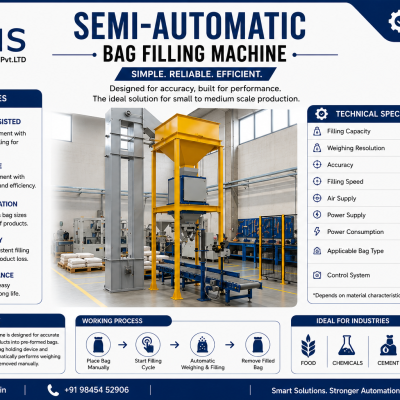
Indus semi-automatic bag filling machines are rated at ±20 grams absolute accuracy across a 5 kg to 50 kg capacity range. Several competing machines in the cattle feed and general bagging segment advertise accuracy in the ±0.2% to ±0.5% range instead. Converted to the same units across that full capacity range, here’s what that actually means:
| Bag Weight | ±20g as a Percentage | ±0.2%–0.5% Converted to Grams |
|---|---|---|
| 5 kg | 0.40% | 10g – 25g |
| 10 kg | 0.20% | 20g – 50g |
| 15 kg | 0.13% | 30g – 75g |
| 20 kg | 0.10% | 40g – 100g |
| 25 kg | 0.08% | 50g – 125g |
| 40 kg | 0.05% | 80g – 200g |
| 50 kg | 0.04% | 100g – 250g |
Read honestly, this table tells a more useful story than a blanket “we’re always more accurate” claim would. At the smallest bag size in the range — 5 kg — a ±20g absolute spec (0.40%) sits inside the competitor’s stated ±0.2%–0.5% window, not clearly ahead of it. The two specs converge around the 10 kg mark, where ±20g and the tightest commonly advertised percentage claim (±0.2%) work out to exactly the same real-world tolerance.
Above 10 kg, the gap opens quickly and keeps opening. At 25 kg, a flat ±20g tolerance is roughly 2.5 to 6 times tighter than the ±0.2–0.5% range converted to grams. At 50 kg, it’s 5 to over 12 times tighter. For the bag weights that dominate cattle feed, fertilizer, bulk grain, and cement sample bagging — mostly in the 20–50 kg band — that’s not a marginal difference. It’s a materially different real-world tolerance, and it’s invisible until someone runs the conversion.
Resolution Is Not Accuracy — A Distinction Worth Knowing
There’s a second confusion that’s arguably more important than the grams-versus-percentage question, and it shows up on spec sheets constantly: resolution is not the same thing as accuracy, even though the two get blurred together often enough that it’s worth checking deliberately.
Resolution — sometimes called “least count” — is the smallest increment a weighing system can register or display. Accuracy is how close the actual delivered weight comes to the target, in real-world operating conditions, accounting for everything from product flow variability to mechanical settling time. A system can have fine resolution and still deliver mediocre real-world accuracy, because resolution only describes what the display can show, not what the machine reliably achieves bag after bag.
This isn’t a hypothetical concern. Industry analysis of India’s weighing equipment market has noted that Indian Legal Metrology follows OIML guidelines in principle but has not yet formalized specific rules for load cell certification — and as a result, the market includes weighing equipment where a system’s least count gets marketed as though it were its accuracy. In practice, that means a “0.5% accurate” claim on some spec sheets may really be describing what the display can resolve to, not what the machine consistently hits under real production conditions.
The way to see past this is to ask for both numbers, separately, and be wary of any manufacturer who only offers one. Indus’s own spec sheet states resolution (10 grams — the smallest increment the system registers) and accuracy (±20 grams — the real-world tolerance achieved) as two distinct figures, not one number doing double duty. That’s not a coincidence; it’s the correct way to disclose a weighing system’s real performance, and it’s worth treating as a minimum bar when you’re evaluating any manufacturer’s claim.
Why This Isn’t Just a Spec-Sheet Curiosity
The gap between a tight and a loose accuracy spec shows up in three places that matter well beyond the purchase decision.
Product giveaway. Operators running a machine with wider real-world tolerance typically compensate by biasing fill weight slightly high, to avoid the reputational and compliance risk of underfilled bags. That small bias, multiplied across thousands of bags a month, is real product handed away for free — and it scales directly with how loose the machine’s actual accuracy is, not with what the spec sheet claims.
Compliance exposure. For bags that fall under India’s Legal Metrology (Packaged Commodities) Rules, declared net quantity has to hold up under sampling and verification. A machine whose real accuracy is looser than advertised puts that compliance margin at risk in exactly the bag-weight range — smaller, consumer-facing packs — where the rules apply most strictly. It’s worth noting this cuts the opposite way from the giveaway problem above: the same wide tolerance that pushes operators to overfill on average is also the tolerance that makes the occasional underfilled bag more likely, since a wider band means more room for a bag to land on the wrong side of the declared weight even with a cautious average bias.
Customer trust. For B2B buyers who spot-check incoming bag weights — and many do — consistent, predictable fill weight is part of what keeps a supplier relationship intact. A machine that drifts within a wide tolerance produces exactly the kind of inconsistency that shows up in a customer’s own quality checks, even when every individual bag technically passes.
None of this requires the worst-case scenario to matter. Even average, unremarkable variation within a loose tolerance compounds into a measurable cost and a measurable risk over a production year.
A Worked Example: What Loose Accuracy Actually Costs
The giveaway effect described above is easier to dismiss as theoretical than to see in numbers, so it’s worth working through one illustrative example.
Picture a mid-scale operation filling 25 kg bags, running a representative 3,000 bags a month. On a machine with a genuinely loose ±125g tolerance (the top end of the ±0.5% range at this bag weight), an operator managing underfill risk typically biases the average fill somewhat above nominal — commonly by 50–60g or more — simply to stay comfortably clear of the lower bound on every bag. On a machine holding a real ±20g tolerance, that same margin of safety only requires a bias of roughly 8–10g above nominal, because the tolerance band itself is so much narrower.
The difference — call it 40–50g per bag, as an illustrative mid-point — multiplied across 3,000 bags a month works out to somewhere in the range of 120–150 kg of product given away every month that a tighter-tolerance machine simply wouldn’t need to give away. Over a year, that’s more than a ton and a half of product handed out for free, not because anyone did anything wrong, but because a wider tolerance forces a wider safety margin.
This example uses round, illustrative figures rather than measured data from any specific plant, and the actual bias any operator applies varies by product, packaging line, and internal quality policy. The mechanism, though, is real and consistent: tolerance width and giveaway bias move together, and a tighter accuracy spec — genuinely tighter, in grams, at your actual bag weight — is one of the few packaging-line variables that reduces cost every single month without requiring any change in behavior on the floor.
How to Verify a Manufacturer’s Accuracy Claim
A spec sheet number is a starting point, not proof. Before you rely on an accuracy claim, it’s worth asking:
- What’s the figure in grams, at my actual bag weight? If a supplier only quotes a percentage, ask them to convert it for your specific capacity — and do the math yourself against what they give you.
- What’s the resolution, separately from the accuracy? If a manufacturer can only give you one number, that’s worth treating as a caution flag rather than a reassurance.
- Is the load cell OIML-certified, and to what class? OIML R60 is the international standard for load cell accuracy classification, and reputable manufacturers serving commercial and industrial weighing applications typically reference it directly rather than an unspecified “high accuracy” claim.
- How was the figure tested — with your actual product, or a reference weight? Real product (with its own density and flow variability) often behaves differently than a lab test weight. Ask whether the stated accuracy holds with your specific material, not just under ideal conditions.
- Can you see it demonstrated with your own product before you commit? A live trial with your actual material is the only way to confirm a stated tolerance translates into real performance on your production floor.
What Actually Determines Real-World Accuracy
The spec sheet number is only the starting point. Several factors determine whether a machine actually holds that tolerance in daily production:
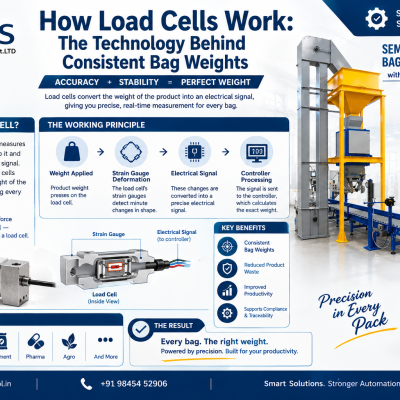
Load cell quality. Higher-grade, OIML-certified load cells hold their calibration more consistently over time and under load than uncertified or lower-spec alternatives — this is the single biggest factor behind the resolution-versus-accuracy gap discussed above.
Controller and digital filtering. A well-tuned controller filters out mechanical noise and vibration before it affects the reading, rather than letting every small disturbance register as a weight change.
Feed mechanism design. Machines that shift from a coarse, fast feed to a slower, fine “dribble” feed as the target weight approaches hold tighter tolerances than single-speed feed systems, because the final grams are added more gradually and precisely.
Calibration discipline. A machine calibrated correctly at installation and checked periodically holds its stated accuracy far better than one calibrated once and left alone indefinitely — this is as much an operational habit as a machine specification.
Product characteristics. Even the best machine can only work with what it’s given. Products with inconsistent density, high moisture variability, or irregular particle size make tight accuracy genuinely harder to hold — which is worth discussing honestly with a manufacturer rather than assuming any machine performs identically regardless of material.
Environmental conditions. Vibration from nearby equipment, dust accumulation on load cell mounts, and temperature swings in the plant can all introduce small measurement errors over time, independent of the machine’s design quality. A well-engineered installation isolates the weighing platform from external vibration and specifies environmental protection appropriate to the plant — details that rarely appear on a spec sheet but noticeably affect whether stated accuracy holds up in practice.
Every one of these factors interacts with the others — a top-grade load cell installed without vibration isolation, or run against a product with wildly inconsistent density, won’t hold its rated accuracy no matter how good the number on the spec sheet is. That’s precisely why the verification questions above matter more than the number itself.
A bag filling machine accuracy spec is only useful once it’s converted into the same units as the machine you’re comparing it against. Run the math honestly across your actual bag weight range, and a flat ±20g tolerance holds up competitively even at the smaller end of a 5–50 kg range, and pulls decisively ahead — often 5 to 12 times tighter — at the 25–50 kg weights that dominate cattle feed, fertilizer, grain, and cement sample bagging.
The bigger habit worth taking away, though, isn’t this specific comparison — it’s the practice of never accepting an accuracy claim at face value. Ask for the number in grams at your bag weight, ask for resolution separately from accuracy, ask whether the load cell carries OIML certification, and ask to see it run with your own product. A manufacturer confident in their numbers will welcome all four questions.
Frequently Asked Questions
Is ±20 grams a good accuracy spec for a bag filling machine?
It depends entirely on your bag weight. At 5 kg, ±20g works out to 0.40% of target weight — comparable to typical mid-range specs. At 25–50 kg, the same ±20g absolute tolerance works out to 0.04–0.08%, which is considerably tighter than the ±0.2–0.5% commonly advertised for machines in that capacity range. Always convert to the same unit as your actual bag weight before judging.
Why do some manufacturers quote accuracy in percentage instead of grams?
Percentage figures scale automatically across a machine’s full capacity range, so a single number can describe performance across a wide 5–50 kg span. That’s convenient for marketing, but it also means the same percentage represents a very different real-world tolerance at the low end of the range versus the high end — which is exactly why converting to grams at your specific bag weight matters before comparing.
What’s the difference between accuracy and resolution on a bag filling machine?
Resolution (or “least count”) is the smallest increment the weighing system can register or display. Accuracy is how close the actual delivered weight comes to the target under real production conditions. A machine can have fine resolution and still deliver looser real-world accuracy — the two numbers should always be stated separately, and a manufacturer offering only one is worth questioning.
How can I verify a manufacturer’s stated accuracy is real?
Ask for the accuracy in grams at your specific bag weight, ask for resolution as a separate figure, ask whether the load cell is OIML-certified and to what class, and ask to see the machine run with your actual product rather than a reference test weight. A live, on-site trial is the most reliable verification available.
Does tighter accuracy really affect cost, or is it just a spec-sheet detail?
It affects cost in three concrete ways: product giveaway (operators on loosely-toleranced machines tend to overfill slightly to avoid underweight risk), compliance exposure under Legal Metrology rules for consumer-facing bags, and customer trust with B2B buyers who spot-check incoming weights. None of these require a worst-case scenario — ordinary variation within a wide tolerance compounds over a production year.
Does a semi-automatic bag filling machine sacrifice accuracy compared to a fully-automatic one?
No — weighing accuracy is a function of the load cell and controller, not the level of bag-handling automation around them. A well-built semi-automatic machine can match the accuracy of a fully-automatic system built on the same weighing technology, which we cover in more detail in our semi-automatic vs. fully-automatic comparison.
Does higher accuracy always mean a higher price?
Generally yes, since tighter accuracy typically requires a higher-grade, certified load cell and more careful calibration during manufacturing — both genuine cost inputs, not markup. Whether that premium is worth paying depends on your bag weight and how much giveaway or compliance risk a looser tolerance would actually create for your specific product, which is covered in what actually drives bag filling machine cost in India.
How often should a bag filling machine be recalibrated?
There’s no single universal interval — it depends on usage intensity, product characteristics, and environmental conditions — but a machine that’s calibrated once at installation and never checked again is the single most common way a genuinely well-specified machine drifts away from its rated accuracy over time. Periodic verification, especially for bags falling under Legal Metrology requirements, should be a standing item in your maintenance schedule, not an afterthought.