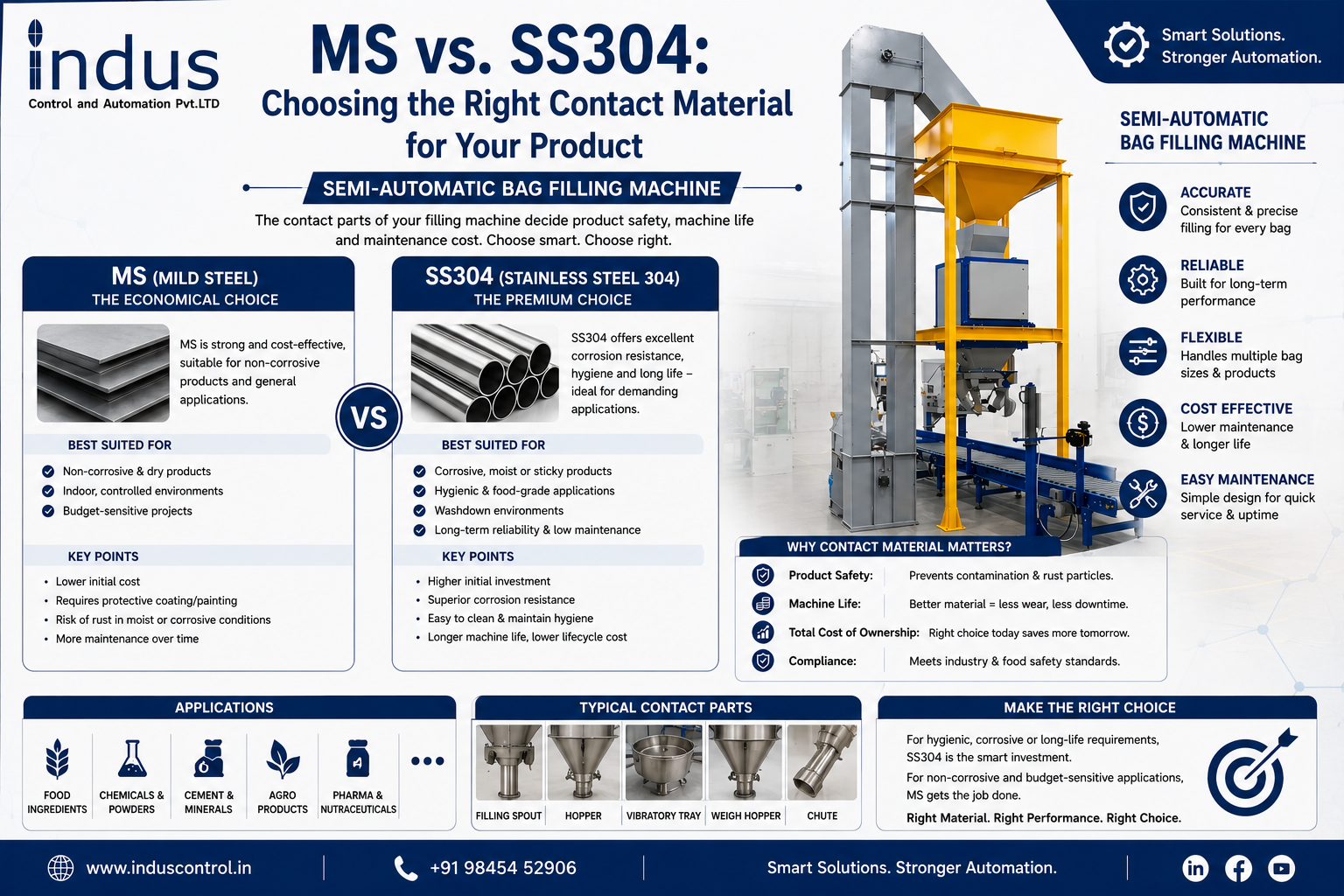
Somewhere on almost every bag filling machine quotation is a single line that quietly moves the price more than nearly any other spec: construction material. MS vs SS304 looks, on paper, like a simple upgrade decision — pay more, get stainless. In practice, it’s a materials-engineering question with a genuinely correct answer for your product, and getting it wrong in either direction costs you: overspend on stainless you didn’t need, or under-spec mild steel into a job that corrodes, contaminates, or fails inspection.
This guide breaks the decision down properly — what each material actually is, where each one belongs, and the handful of factors that should drive your choice instead of a default assumption that “stainless is always safer” or “mild steel is always cheaper and fine.”
In this guide:
- What “contact parts” actually means (and why it’s not an all-or-nothing choice)
- What mild steel is, and where it genuinely fits
- What SS304 is, and where it genuinely fits
- A head-to-head comparison
- The real factors that should decide your material choice
- Industry-by-industry recommendations
- Common mistakes buyers make in both directions
- FAQs
What “Contact Parts” Actually Means
Before comparing materials, it’s worth clearing up a misconception that inflates a lot of quotations unnecessarily: choosing SS304 doesn’t have to mean the entire machine is stainless.
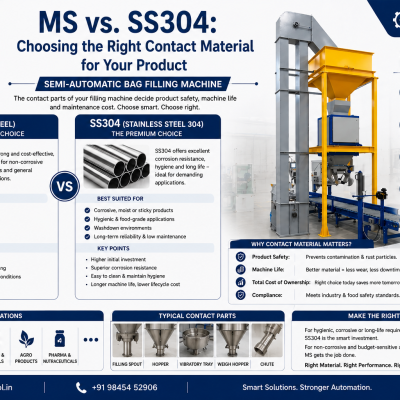
“Contact parts” refers specifically to the surfaces that actually touch the product — the hopper, feed chute, filling spout, and any internal surface the material passes over on its way into the bag. The structural frame, housing, and non-contact components can often remain mild steel even on a machine specified with SS304 contact parts, because hygiene and corrosion resistance only matter where the product itself is present.
This distinction matters because it’s rarely offered by default — most quotations either present a fully MS machine or a fully SS304 one, and the hybrid option (SS304 where it matters, MS everywhere else) has to be requested explicitly. If your product genuinely needs stainless contact surfaces but your budget is sensitive to a full-stainless build, this is the question to ask before assuming you have to choose between “cheap and unsuitable” or “correct but expensive.” It’s a five-minute conversation with a manufacturer that can meaningfully change what ends up on your final quotation.
What Is Mild Steel (MS)? Properties and Where It Fits
Mild steel is a low-carbon steel alloy — strong, weldable, widely available, and significantly less expensive than stainless grades because it contains no chromium or nickel. Its defining weakness is exactly what those elements would otherwise prevent: mild steel corrodes when exposed to moisture, and it offers no meaningful resistance to acidic or reactive materials without an added coating or finish.
That weakness is irrelevant for a large share of industrial packaging applications. Dry, non-corrosive, non-food materials — construction inputs, many fertilizers, most industrial minerals, and a wide range of non-reactive powdered chemicals — don’t expose the machine to the conditions mild steel is vulnerable to. In those applications, mild steel isn’t a compromise; it’s the appropriately specified, cost-efficient choice, and paying a premium for stainless contact parts would be solving a corrosion problem that was never going to occur.
Mild steel’s practical limits show up fast, though, once moisture, acidity, or food-contact hygiene requirements enter the picture — which is exactly where SS304 takes over.
What Is SS304 (Stainless Steel)? Properties and Where It Fits
SS304 — sometimes called “18/8” stainless for its approximate 18% chromium and 8% nickel content — forms a thin, self-repairing chromium oxide layer on its surface that gives it genuine corrosion resistance rather than a coating that can wear off. That same property makes it non-reactive with most food products, resistant to a wide range of cleaning agents, and capable of holding a smooth, non-porous finish that doesn’t harbor bacteria the way a rougher or corroded surface would.
For food-contact equipment in India, this isn’t just a quality preference — it’s close to a regulatory baseline. FSSAI’s food-contact surface requirements call for non-toxic, non-absorbent, rust-free material, and food-grade stainless steel — SS304 or above — is the standard manufacturers build to for exactly this reason. Requirements at this level extend explicitly to packaging machinery, hoppers, and similar product-contact equipment, not just visible kitchen surfaces.
SS304 isn’t the only stainless grade in use — SS316 adds molybdenum for additional corrosion resistance and is more common in pharmaceutical, marine, or highly corrosive chemical environments — but SS304 is the standard, cost-appropriate choice for the large majority of food, feed, and general chemical packaging applications where corrosion resistance and hygiene matter without those more extreme conditions.
How to Verify You’re Actually Getting SS304
“SS304” on a quotation is a claim, not a guarantee — and there’s a real financial incentive for it to be misrepresented. SS304’s nickel content makes it genuinely more expensive to produce than SS202, a lower grade that substitutes much of that nickel with manganese and nitrogen. Polished and finished, SS202 can look nearly identical to SS304 to the naked eye, while offering meaningfully worse corrosion and pitting resistance — precisely the properties you’re paying the SS304 premium for in the first place.
This isn’t a reason for blanket suspicion of every supplier, but it is a reason to verify rather than simply take a spec sheet’s word for it:
- Ask for a material test certificate (MTC) for the specific grade used, not just a general “stainless steel” claim. A manufacturer genuinely sourcing SS304 should produce this without hesitation.
- Ask which grade is used for contact parts specifically, not just the machine generally — a quotation listing “stainless steel construction” without naming the grade leaves ambiguity worth closing before you order.
- Know that a magnet test alone isn’t reliable. Both SS304 and SS202 are largely non-magnetic in their normal state, so a magnet failing to stick doesn’t confirm the grade either way, despite being a common assumption in the market.
- A basic spark test is a real, if rough, field indicator. SS304 produces thin, reddish-orange sparks that don’t travel far when ground; SS202 produces thicker, yellow sparks that spread further. It’s not a substitute for a certificate, but it’s a reasonable sanity check.
Treat the request for documentation as routine, not adversarial — a manufacturer confident in their material sourcing will treat it the same way, and a semi-automatic bag filling machine spec’d in genuine SS304 is worth confirming before it becomes part of a production line you’re relying on for years.
MS vs. SS304: Head-to-Head Comparison
| Factor | Mild Steel (MS) | SS304 Stainless Steel |
|---|---|---|
| Corrosion resistance | Poor without coating; rusts with moisture exposure | Strong — self-repairing oxide layer resists most moisture and mild chemical exposure |
| Hygiene / cleanability | Adequate for dry, non-food materials | Smooth, non-porous, meets food-contact hygiene expectations |
| Relative cost | Lower | Higher — real raw material and fabrication premium |
| Durability in the right setting | Excellent for dry, non-corrosive use | Excellent across a wider range of conditions, including moisture and mild chemical exposure |
| Fabrication and welding | Faster, more widely available skill | Slower, more specialized finishing needed for food-grade standard |
| Regulatory fit for food contact | Not suitable for food-contact surfaces | Meets FSSAI food-contact expectations |
| Best suited to | Cement, sand, plaster, many fertilizers, dry non-reactive minerals and chemicals | Food grains, sugar, dairy-adjacent products, moisture-sensitive or corrosive chemicals |
The pattern is straightforward once it’s laid out: SS304 isn’t a universal upgrade, and MS isn’t a universal compromise. Each is the correct engineering choice within its own range of conditions.
The Real Factors That Should Decide Your Material Choice
The comparison table gives you the shape of the decision. These are the specific questions that actually settle it for your product.
1. What Are You Packing — Moisture and Corrosiveness
This is the single biggest factor. Dry, stable, non-reactive materials — cement, sand, dry fertilizer granules, most industrial minerals — simply don’t create the conditions mild steel is vulnerable to, which is why MS remains the standard, sensible choice across construction materials and much of the fertilizer segment. Products with meaningful moisture content, acidity, or reactive chemistry — many food products, some chemical formulations, anything hygroscopic that draws moisture from the air — will accelerate corrosion on mild steel contact surfaces over time, which is where SS304 stops being a preference and starts being a requirement.
2. Regulatory and Food-Safety Requirements
If your product is intended for human or animal consumption and falls under food-safety regulation, this factor overrides cost considerations. FSSAI’s expectations for food-contact surfaces — non-corrosive, smooth, easy to clean, non-toxic, food-grade — are written around exactly what SS304 (or better) delivers and mild steel does not. This applies to food grains, sugar, and similar consumer-facing products without much ambiguity; it’s worth checking explicitly for animal feed and protein products too, since requirements can apply there depending on your specific product and market.
3. Environmental Conditions at Your Plant
The material decision isn’t only about the product — it’s also about the air the machine sits in. Facilities in humid regions, coastal areas, or environments with airborne dust that retains moisture put more corrosion stress on mild steel than the same machine would experience in a dry inland facility, even packing an identical product. A plant in a coastal city, for instance, deals with salt-laden air that accelerates corrosion on unprotected mild steel regardless of what’s moving through the hopper — a factor that’s easy to overlook when the material decision is framed purely around the product being packed. If your plant environment itself is a factor, that’s worth raising with your manufacturer directly rather than assuming your product alone determines the right material.
4. Cleaning and Hygiene Protocols
How often, and how aggressively, a machine gets washed down matters as much as what passes through it. Frequent washdown with water or cleaning agents — common in food, dairy-adjacent, and some chemical operations — accelerates corrosion on unprotected mild steel far faster than dry operation would, even with the same product. If your operation involves regular wet cleaning, that alone can tip the decision toward SS304 even for a product that wouldn’t otherwise demand it.
5. Long-Term Cost, Not Just the Purchase Price
Mild steel’s lower upfront cost can be a false economy in the wrong application. A machine that corrodes prematurely because it was under-specified for its actual operating conditions faces earlier part replacement, more frequent maintenance, and — for food-contact applications — a genuine compliance and contamination risk that carries costs well beyond the machine itself. Evaluated over the full working life of the equipment rather than the purchase order alone, the “cheaper” material isn’t always the lower-cost choice — a point we cover in more depth in what actually drives bag filling machine cost in India, where construction material is one of several factors that shape a quotation far more than buyers typically expect.
6. The Hybrid Option: SS304 Where It Matters, MS Where It Doesn’t
As covered above, contact-part-only stainless specification is often available and worth asking about explicitly. For operations where only the fill path needs food-grade or corrosion-resistant material — while the surrounding frame and housing never touch the product — this hybrid approach can deliver the correct material exactly where it’s needed without paying a full-stainless premium on structural components that don’t require it.
Industry-by-Industry: Which Material Fits Better?
Food grains (rice, wheat, sugar, dal, pulses). SS304 is the standard, appropriate choice here — these are food-contact applications where FSSAI expectations apply directly, and the hygiene and corrosion-resistance benefits are worth the premium without much debate.
Animal feed (cattle feed, poultry feed, fish meal). This varies by product and market. Formulations with higher moisture or fat content, or feed intended for markets with food-safety-adjacent requirements, often justify SS304; drier, more stable formulations frequently run well on mild steel. Worth evaluating product by product rather than assuming one answer for the whole category.
Chemicals (powdered chemicals, minerals, additives). This is the category where the decision genuinely depends on the specific chemistry. Non-reactive, dry powders are commonly packed on mild steel; corrosive, hygroscopic, or moisture-sensitive chemical products typically require SS304 or, in more demanding cases, SS316.
Fertilizers (granular and powdered). Mild steel is standard for most fertilizer bagging, since the majority of formulations are dry and non-corrosive at the point of packaging — though certain formulations with higher moisture retention or corrosive characteristics are exceptions worth flagging to your manufacturer.
Construction materials (cement, sand, plaster). Mild steel is the appropriate, cost-efficient standard across this entire category. These are dry, non-corrosive, non-food materials where a stainless upgrade would add cost without addressing any real operating condition.
Common Mistakes Buyers Make
Two opposite mistakes show up regularly, and both are avoidable with the questions above.
Over-specifying SS304 out of caution. It’s an understandable instinct — stainless sounds like the safer, more premium choice, and nobody wants to be the buyer who chose “the cheap option” — but paying a stainless premium on a machine packing dry cement or fertilizer isn’t caution, it’s an unnecessary cost with no corresponding benefit. If your product and environment don’t create corrosion risk, mild steel isn’t a compromise.
Under-specifying mild steel for food or moisture-exposed products. The opposite mistake is more consequential: choosing mild steel to save cost on a product that genuinely needs stainless — food-contact applications, moisture-sensitive chemicals, or frequently washed-down equipment — trades a one-time saving for ongoing corrosion, maintenance, hygiene risk, and in food applications, real regulatory exposure. This is the direction worth erring away from when there’s genuine uncertainty.
MS vs. SS304 isn’t a budget-versus-quality decision — it’s a materials-engineering question with a genuinely correct answer once you know what you’re packing, under what conditions, and under what regulatory expectations. Mild steel is the right, cost-efficient choice for dry, non-corrosive, non-food materials like cement, sand, and many fertilizers. SS304 is the right choice — not just the safer one — for food grains, moisture-sensitive products, and anything falling under food-safety regulation. And when the grade genuinely matters, it’s worth confirming with a certificate rather than assuming a spec sheet tells the whole story.
Indus Control and Automation builds bag filling machines in both mild steel and SS304, including hybrid configurations with stainless contact parts on a mild-steel frame, specified around your actual product and operating conditions rather than a default assumption in either direction. If you’re not certain which side of this decision your product falls on, that’s exactly the kind of question worth raising before you finalize a spec — a short conversation about your material, your plant environment, and your cleaning routine is usually enough to settle it.
Frequently Asked Questions
Buyers evaluating a quotation tend to ask a consistent set of questions once material becomes part of the conversation — these are the ones worth having answered before you sign off on a spec.
What’s the actual difference between MS and SS304 for a bag filling machine?
Mild steel is a lower-cost carbon steel with no meaningful corrosion resistance, suited to dry, non-reactive materials. SS304 stainless steel contains chromium and nickel that form a self-protecting oxide layer, giving it genuine corrosion resistance and a smooth, hygienic, food-grade-compliant surface — at a real cost premium over mild steel.
Do I need SS304 for a bag filling machine if I’m not packing food products?
Not necessarily. The deciding factors are moisture exposure, chemical corrosiveness, cleaning frequency, and regulatory requirements — not simply whether the product is food. Many non-food chemicals, fertilizers, and construction materials run perfectly well on mild steel; some non-food products with high moisture or corrosive characteristics genuinely need stainless regardless.
Does the entire machine need to be SS304, or just the parts touching the product?
Just the contact parts in most cases — the hopper, chute, and filling spout — while the surrounding frame and housing can remain mild steel. This hybrid approach is often available but has to be requested explicitly, since most quotations default to presenting an all-MS or all-SS304 machine rather than offering the combination.
Is SS304 required by law for food packaging equipment in India?
FSSAI’s food-contact surface requirements call for non-corrosive, rust-free, food-grade material, and food-grade stainless steel — SS304 or above — is the standard manufacturers build to in order to meet that requirement. If your product falls under food-safety regulation, SS304 contact parts should be treated as a baseline expectation rather than an optional upgrade.
Is SS316 ever necessary instead of SS304?
For most food, feed, and general chemical packaging applications, SS304 is sufficient and appropriately priced for the job. SS316 adds molybdenum for additional corrosion resistance and is more commonly specified for pharmaceutical-grade, marine, or highly corrosive chemical environments — worth discussing with your manufacturer if your product falls into one of those more demanding categories.
Does mild steel construction mean a machine won’t last as long?
Not in the applications mild steel is actually suited to. A mild steel machine packing dry, non-corrosive material like cement or stable fertilizer can run reliably for years with normal maintenance. Mild steel’s durability problem only appears when it’s used outside its appropriate range — exposed to moisture, corrosive chemistry, or frequent washdown it wasn’t specified to handle.
How do I know which material is right for my specific product?
Start with three questions: does your product or its handling involve meaningful moisture or corrosive chemistry, does it fall under food-safety regulation, and how often is the machine washed down? If the answer to any of these is yes, SS304 — at minimum on contact parts — is worth serious consideration. If the answer to all three is no, mild steel is very likely the appropriately specified, cost-efficient choice.
Should I ask for a material certificate when buying an SS304 machine?
Yes. Because SS304 costs more to produce than lower grades like SS202, and the two can look nearly identical once polished, a material test certificate for the specific grade used is reasonable, standard due diligence — not an unusual or distrustful request. Ask for it as part of your quotation review, before the machine is built, rather than after installation when verification is far less practical.