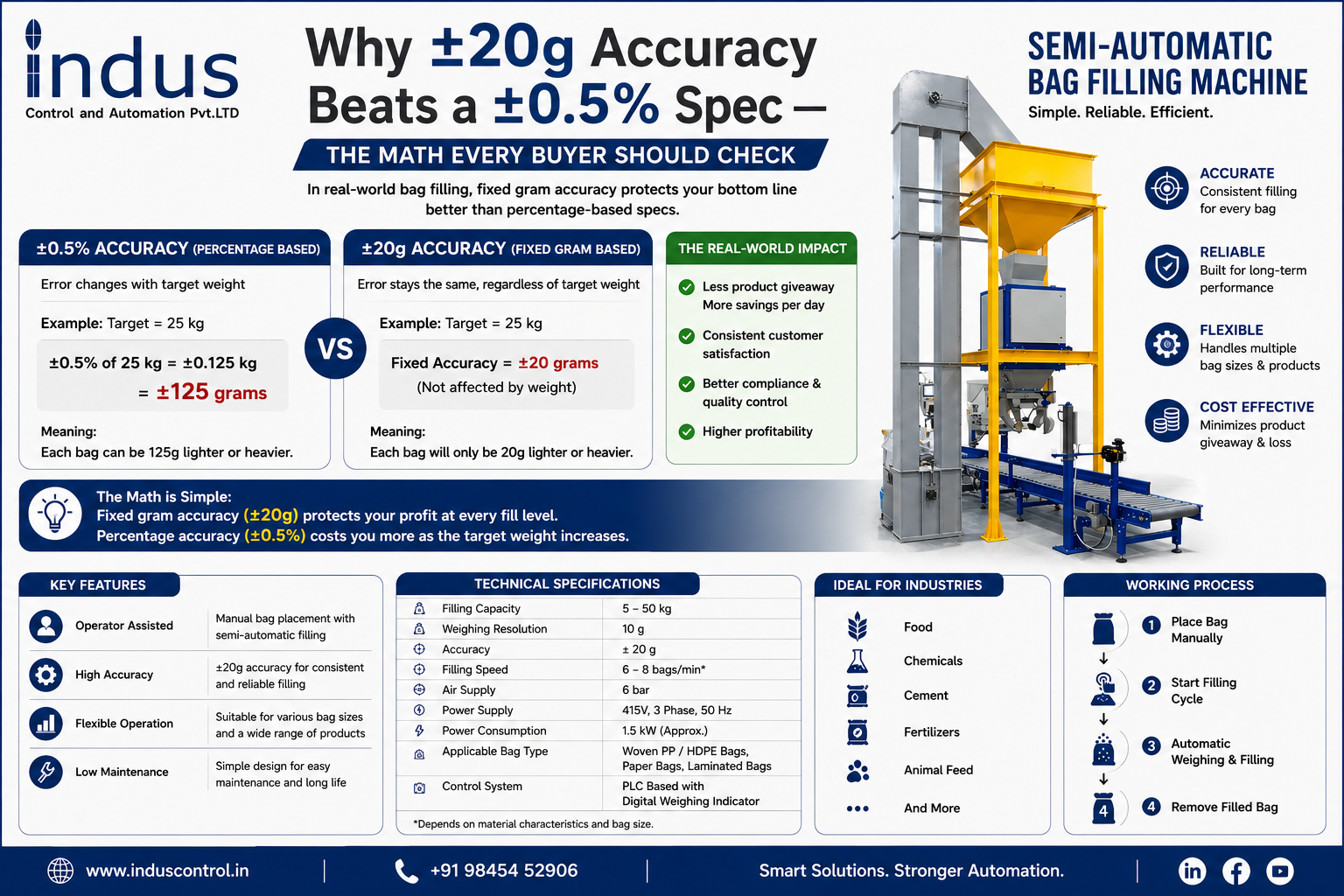
Two bag filling machine spec sheets sit side by side. One shows an accuracy of ±20 grams. The other lists an accuracy of ±0.5%.
Which machine is tighter? Most buyers cannot answer that question on sight.
Comparing grams and percentages without converting them is like comparing prices in different currencies. That confusion allows loose accuracy specs to look precise until you do the math.
This guide works through that conversion math across common bag weights from 5 kg to 50 kg. We also explain the difference between accuracy and resolution so you can evaluate equipment quotes confidently.
In This Guide:
- Why grams and percentage specs are not directly comparable
- The simple conversion math explained
- A full side-by-side comparison across 5 kg to 50 kg capacity
- Why resolution differs from real-world accuracy
- The hidden costs of inaccurate weighing
- How to verify accuracy claims before you order
- Key factors that determine real-world performance
- Frequently asked questions
Why Accuracy Specs Cause Confusion
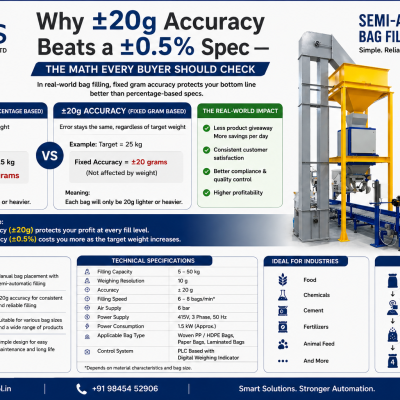
Manufacturers express bag filling machine accuracy in two standard ways. They use absolute figures in grams (±20g, ±50g) or percentage values (±0.2%, ±0.5%). Both methods describe performance, but they behave differently as bag sizes change.
An absolute gram spec stays identical across all bag sizes. A ±20g specification means ±20g whether you fill 5 kg of spice or 50 kg of cement.
Conversely, a percentage spec scales with the total bag weight. A ±0.5% tolerance creates a tight window on a 5 kg bag, but it allows a wide range on a 50 kg bag.
Without converting these units, you cannot make a direct comparison. That hidden gap leads buyers to make expensive assumptions.
The Math: Converting Between Grams and Percentages
Converting between percentages and grams requires two simple formulas:
- Percentage to grams: Multiply the percentage decimal by the target bag weight in grams.
- Example: $0.5\%$ on a $25\text{ kg}$ bag $= 0.005 \times 25,000\text{g} = 125\text{g}$ tolerance.
- Grams to percentage: Divide the gram tolerance by the target bag weight in grams.
- Example: $\pm 20\text{g}$ on a $25\text{ kg}$ bag $= 20 \div 25,000 = 0.0008 = 0.08\%$.
Applying these formulas brings both specifications to the same unit for a fair comparison.
The Real Comparison: ±20g vs. ±0.2%–0.5% Across Capacity Ranges
Indus semi-automatic bag filling machines offer a flat ±20 grams accuracy across 5 kg to 50 kg ranges. Competing machines often advertise ±0.2% to ±0.5% accuracy instead.
Converting those claims to grams highlights the difference:
| Bag Weight | ±20g as a Percentage | ±0.2%–0.5% Converted to Grams |
| 5 kg | 0.40% | 10g – 25g |
| 10 kg | 0.20% | 20g – 50g |
| 15 kg | 0.13% | 30g – 75g |
| 20 kg | 0.10% | 40g – 100g |
| 25 kg | 0.08% | 50g – 125g |
| 40 kg | 0.05% | 80g – 200g |
| 50 kg | 0.04% | 100g – 250g |
At smaller 5 kg sizes, a ±20g spec equals 0.40%, sitting inside the competitor’s 10g–25g window. The specs match at 10 kg, where ±20g equals ±0.2%.
Above 10 kg, the gap expands rapidly. At 25 kg, a flat ±20g tolerance is 2.5 to 6 times tighter than the ±0.2%–0.5% percentage range.
At 50 kg, the ±20g spec is 5 to 12 times tighter. For 20–50 kg bags used in feed, fertilizer, and grain packaging, this mathematical difference directly affects performance.
Resolution Is Not Accuracy — A Key Distinction
Spec sheets often blur the distinction between resolution and accuracy.
Resolution (or “least count”) means the smallest increment the weighing display shows. Accuracy describes how close the delivered weight matches your target under actual plant conditions. A system can display small increments while delivering inconsistent fill weights.
In India’s market, Indian Legal Metrology follows OIML guidelines generally, but specific load cell certifications vary. Consequently, some suppliers present the least count as their accuracy figure. A “0.5% accurate” label might describe display increments rather than reliable production performance.
To avoid confusion, request both figures separately from your supplier:
- Resolution: System display increment (for example, 10 grams).
- Accuracy: Actual weight tolerance achieved in production (for example, ±20 grams).
What Inaccurate Weighing Costs Your Business
Inaccurate weighing creates three main operational risks:
1. Product Giveaway
Operators facing wide weight tolerances deliberately overfill bags to avoid underweight complaints. Extra grams handed away per bag accumulate into tons of wasted product yearly.
2. Regulatory Compliance Risks
Bags governed by Legal Metrology rules require accurate net weight declarations. Loose tolerances increase the risk of underfilled bags during spot audits, exposing your company to legal penalties.
3. Customer Trust Issues
B2B buyers routinely verify incoming bag weights. Inconsistent fill weights harm commercial trust, even if individual bags pass basic checks.
A Worked Example: Calculating Product Giveaway Costs
Consider a plant filling 3,000 bags monthly at 25 kg per bag:
- On a machine with a loose ±125g tolerance (the upper end of a ±0.5% spec), operators often add a 50g–60g safety margin per bag to prevent underfilling.
- On a machine holding a tight ±20g tolerance, that safety margin drops to roughly 8g–10g per bag.
That difference averages about 40g–50g saved per bag. Multiplying 45g across 3,000 bags equals 135 kg of saved product each month.
Over a year, that tighter accuracy saves over 1.6 tons of product without changing plant operations.
How to Verify Manufacturer Accuracy Claims
Ask suppliers these five questions before placing an order:
- What is the accuracy in grams for my exact bag size? Convert percentage claims using your target weight.
- What is the display resolution separate from accuracy? Ensure the supplier provides two distinct values.
- Is the load cell OIML-certified? Verify the certification standard, such as OIML R60.
- Was accuracy tested using real product? Confirm whether tests used actual material rather than ideal lab weights.
- Can we schedule a live trial with our material? Test performance using your own product before finalizing the order.
What Determines Real-World Accuracy?
Several key equipment components determine whether a machine holds its rated tolerance:
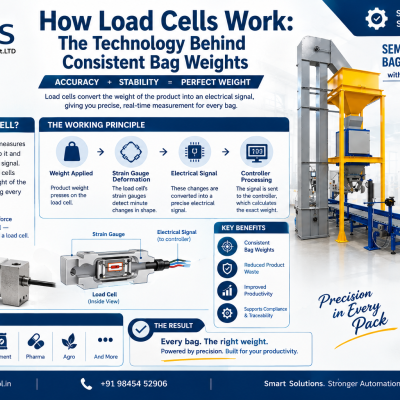
- Load Cell Quality: OIML-certified load cells maintain calibration stability over time.
- Controller Filtering: Advanced digital filtering eliminates mechanical noise and plant vibration.
- Feed Mechanism: Dual-speed feed systems (coarse and fine dribble) deliver accurate final weights.
- Routine Calibration: Regular calibration checks preserve machine precision.
- Product Flow Behavior: Consistent bulk density and moisture levels support tighter filling control.
- Factory Environment: Isolating the scale from floor vibration and temperature swings prevents measurement drift.
Conclusion
An accuracy claim becomes meaningful only after you convert it to absolute grams for your target bag size.
A flat ±20g tolerance offers strong performance across 5–50 kg ranges, outperforming loose percentage claims on larger bags.
Always request exact figures in grams, verify load cell certifications, and run live trials with your material to ensure accurate performance.
Frequently Asked Questions
Is ±20 grams a good accuracy spec?
It depends on your bag weight. At 5 kg, ±20g equals 0.40%. At 25–50 kg, ±20g represents an accurate 0.04%–0.08% tolerance.
Why do suppliers quote accuracy in percentages?
Percentages provide a single figure across broad weight ranges, simplifying marketing descriptions. However, converting to grams reveals the true tolerance for your specific bag size.
What separates accuracy from resolution?
Resolution is the smallest weight increment shown on the display. Accuracy reflects actual weight tolerance under operating conditions.
How do I verify accuracy claims?
Request the gram tolerance for your bag size, verify OIML load cell certification, and test the machine with your material.
Does tight accuracy reduce operating costs?
Yes. Tighter accuracy minimizes product giveaway, ensures regulatory compliance, and maintains consistent packaging quality.
Are semi-automatic machines less accurate than fully automatic models?
No. Weighing accuracy depends on load cell and controller quality rather than the level of bag-handling automation.
Does higher accuracy increase machine price?
Generally yes. Certified load cells and precision controllers increase manufacturing costs, but reduced product giveaway offsets the initial investment.
How often should I recalibrate a filling machine?
Establish regular calibration checks based on production volume, material characteristics, and Legal Metrology requirements to prevent weight drift.