“What’s the price of a bag filling machine?” is the single most-searched question in this category — and it’s also the one question no honest manufacturer can answer with a single number. A bag filling machine price in India can vary enormously between two machines that look nearly identical on a spec sheet, because the price isn’t really set by the category of machine. It’s set by a dozen smaller decisions buried inside that spec sheet.
This guide isn’t a price list, and you won’t find a number in it. Instead, it’s a breakdown of exactly what pushes a bag filling machine’s cost up or down, so that when you do request a quotation, you know precisely what you’re paying for — and whether the quote in front of you is actually comparable to the one sitting next to it.
In this guide:
- Why a single “bag filling machine price” doesn’t really exist
- The core factors that drive cost, one at a time
- Hidden costs buyers often miss until after they’ve bought
- How GST, raw materials, and imported components affect pricing in 2026
- Why the cheapest quote is rarely the best value
- How to get an accurate, apples-to-apples quotation
- FAQs
Why There’s No Single “Bag Filling Machine Price”
Search for a bag filling machine price in India and you’ll find wildly different figures across supplier listings — sometimes for machines that appear, on the surface, to do the same job. That spread isn’t manufacturers being inconsistent. It’s a reflection of how customized industrial packaging equipment actually is.
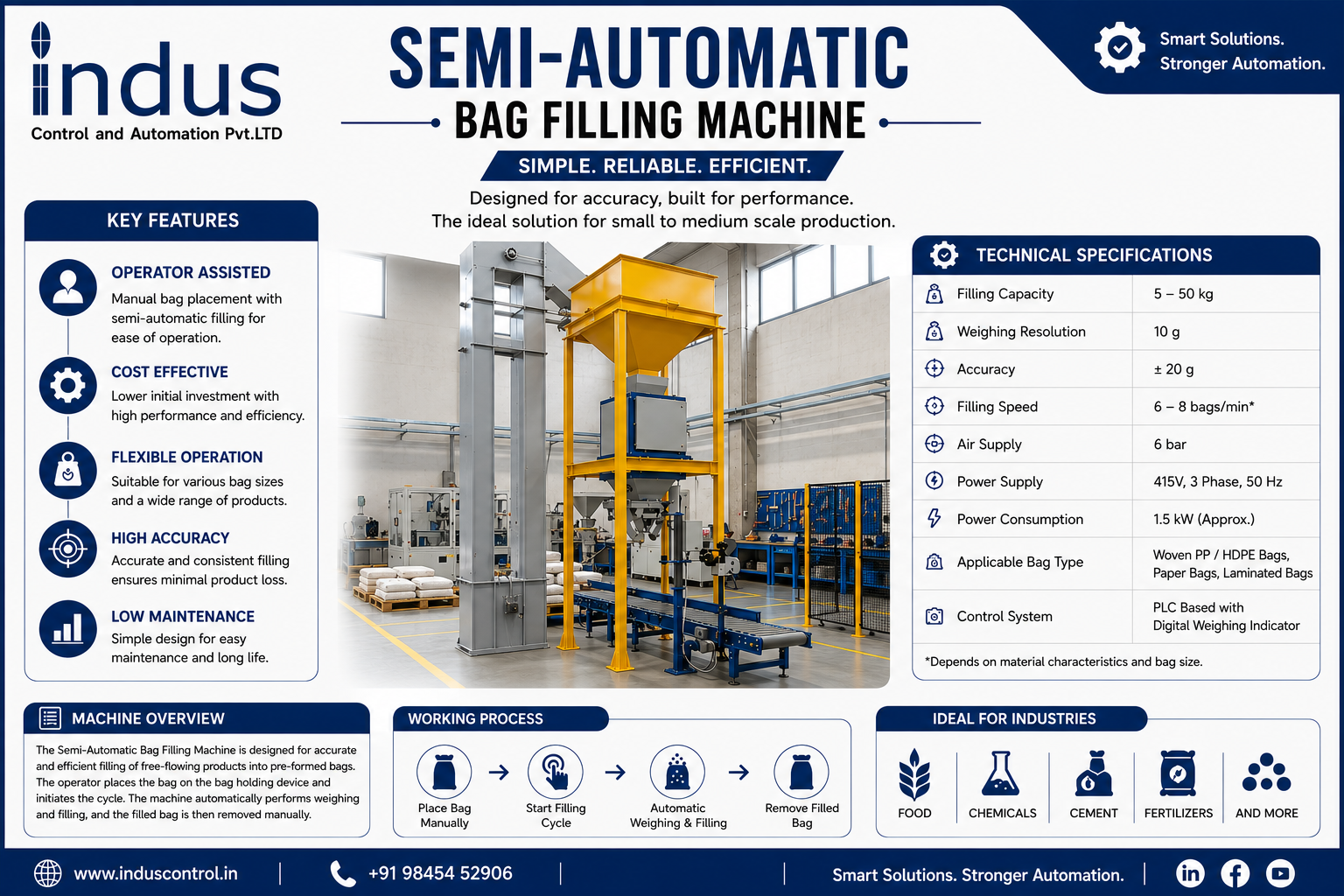
Two “semi-automatic bag filling machines” can differ in weighing accuracy, construction material, controller sophistication, speed, and half a dozen optional accessories — any one of which can move the price meaningfully. A machine quoted for 5–10 kg cattle feed bags with a basic mild-steel frame and manual weight-setting is a fundamentally different product from a 50 kg-capacity, SS304, dust-controlled unit with a PC data-logging interface — even though both would technically list under the same product category.
That’s precisely why a published “price list” for this category is nearly useless on its own. It answers a question (“what’s the cheapest one?”) that isn’t the question that actually matters (“what does my configuration cost?”). The rest of this guide is built to answer the second question — by walking through exactly what you’re paying for.
The Core Cost Drivers
Every quotation you receive is really a sum of the following decisions. Understanding each one is the fastest way to read a quote intelligently — and to make sure you’re comparing like with like.
1. Capacity Range and Weighing System
The weight range a machine is built to handle — say, 5 kg to 50 kg versus a jumbo-bag system built for 500 kg to 1.5 tons — determines the size of the load cell, the structural frame, and the feed mechanism underneath it. A machine engineered for small retail-size bags is a mechanically simpler build than one engineered for bulk industrial bags, and the cost scales accordingly. Buyers sometimes over-specify capacity “just in case,” which quietly inflates cost for headroom they’ll never use — it’s worth sizing this to your actual production range, not your aspirational one.
The width of the capacity range matters too, not just its upper limit. A machine built to hold accuracy consistently across a wide span — say, comfortably filling both 5 kg and 50 kg bags on the same unit — needs a more sophisticated load cell and calibration approach than one built for a narrow band around a single target weight. If your product mix genuinely spans a wide range, that flexibility is worth paying for; if you mostly run one or two bag sizes, a narrower, purpose-built range is usually the more cost-efficient choice.
2. Automation Level: Semi-Automatic vs. Fully-Automatic
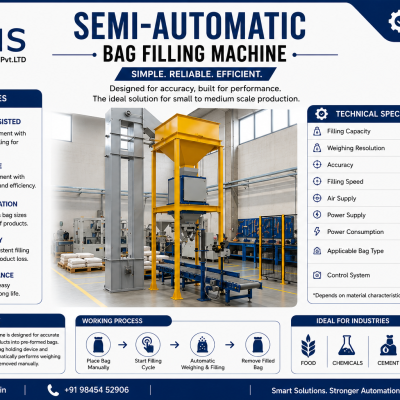
This is usually the single largest lever on price. A semi-automatic bag filling machine automates the weighing and filling while a person places and removes the bag; a fully-automatic system adds automated bag handling, magazine feeding, and often integrated sealing — each of which is its own mechanical and control subsystem layered on top of the same core weighing technology. We’ve broken this comparison down in detail in Semi-Automatic vs. Fully-Automatic Bag Filling Machines: Which Fits a Growing Line? — worth reading before you request quotes on both, since the automation level alone can shift the price far more than any other single factor on this list.
3. Weighing Accuracy and Load Cell Grade
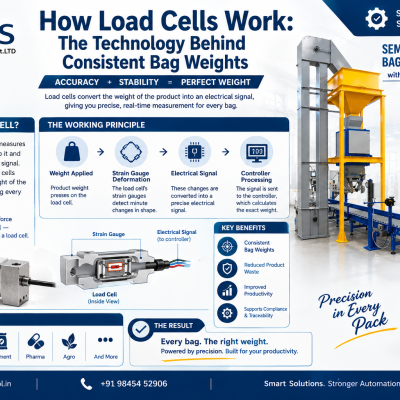
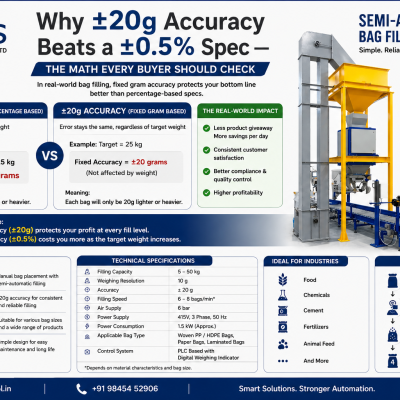
Not all load cells are equal, and accuracy isn’t free. A machine rated for tight tolerances — accuracy expressed in single-digit grams rather than a broad percentage of target weight — uses a higher-grade load cell, more sophisticated digital filtering, and more careful calibration during manufacturing. If your product is sold by declared weight under Legal Metrology rules, or your margins are sensitive to “giveaway” (the small overfill manufacturers add to avoid underweight bags), paying for tighter accuracy usually earns back its premium through reduced product giveaway over the life of the machine.
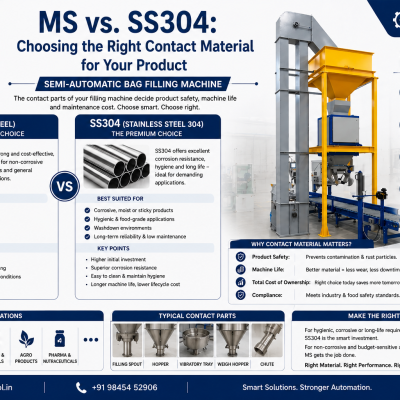
4. Construction Material: Mild Steel vs. SS304
Contact-part material is one of the more visible cost drivers, because it’s a straightforward raw-material difference. Mild steel (MS) construction costs less than SS304 stainless steel, which contains chromium and nickel and commands a real premium as raw material before it’s even fabricated. For non-food, non-corrosive materials — many chemicals, fertilizers, and construction materials — MS is often entirely appropriate and the more cost-effective choice. For food-grade applications, or products where hygiene and corrosion resistance matter, SS304 is usually worth the difference. The right answer depends on what you’re packing, not on defaulting to the more expensive option.
It isn’t only the raw material that costs more, either. SS304 is generally slower and more specialized to weld and finish to a food-grade standard than mild steel, which adds fabrication time on top of the material premium. Some buyers split the difference sensibly — SS304 only on the parts that actually contact the product, with MS for the surrounding frame — which is worth asking a manufacturer whether they offer, since it’s rarely presented as an option unless you request it.
5. Speed and Throughput Requirements
Bags-per-minute targets affect the feed mechanism, pneumatics, and controller response time. A machine built for a modest, steady output requires less engineering than one built to sustain a high bags-per-minute rate without accuracy drifting at speed. If your actual production need is moderate, specifying for maximum theoretical throughput adds cost without adding value — this is another area where matching the spec to real, current production data (not a future best-case scenario) keeps cost proportionate to need.
6. Controller and HMI Sophistication
A basic digital weight indicator costs less than a full HMI touchscreen system with batch totalizers, recipe storage for multiple products, and connectivity options. For a single-product line, a simpler controller may be all you need. For a multi-product operation switching between several weight settings and materials regularly, the more sophisticated HMI often pays for itself in changeover time saved — but it is a genuine line item, not a “comes standard” assumption to make.
7. Optional Accessories and Integrations
This is where quotes diverge the most, because these are genuinely optional and often invisible until you ask. Common additions include a printer interface for weight slips and batch reports, a PC interface for data logging and production monitoring, SMS alerts for remote notifications, a bag flattener or tilter for uniform settling, a dust extraction hood for powdery materials, and an integrated stitching or heat-sealing unit. Each is a real subsystem with its own cost — worth listing explicitly in your enquiry so quotes reflect what you’ll actually use, rather than a bare machine that needs three more line items added later.
8. Customization and Engineering Time
A machine built to a standard configuration costs less than one engineered around a non-standard bag type, an unusual product characteristic (very fine powders, abrasive materials, moisture-sensitive products), or a custom power supply specification. Customization isn’t a markup for its own sake — it reflects genuine engineering time spent making sure the machine handles your specific product correctly rather than approximately.
9. Brand, Engineering Support, and Warranty
Two machines with near-identical spec sheets can still carry different prices because of what stands behind them: in-house engineering versus outsourced fabrication, warranty length and coverage, availability of spare parts, and the quality of after-sales and commissioning support. This is the hardest factor to compare on paper, but it’s often the one that determines your actual cost of ownership — a cheaper machine with weak after-sales support can cost more in downtime than a fairly priced one backed by a manufacturer who answers the phone.
How Cost Drivers Differ by Industry
The same nine factors above apply everywhere, but which ones dominate your quotation shifts a lot depending on what you’re packing:
Food grains (rice, wheat, sugar, dal, pulses). Hygiene and cleanability usually push these buyers toward SS304 contact parts, and gentle product handling to avoid grain breakage matters more than raw speed — both add cost relative to a bare-minimum build, but both are usually worth it for retail-facing food products.
Animal feed (cattle feed, poultry feed, fish meal). These operations often run several formulations and bag sizes through one line, which makes controller sophistication and a wide, stable capacity range more valuable than top-end accuracy or premium materials — mild steel construction is standard here for good reason.
Chemicals (powdered chemicals, minerals, additives). Dust extraction is close to a necessity rather than an optional accessory for many chemical powders, and some products demand corrosion-resistant contact parts regardless of whether the product is food-grade. Accuracy also tends to matter more here, since chemical formulations are often sensitive to dosing precision in ways bulk grain or feed is not.
Fertilizers (granular and powdered). Volume tends to be seasonal and high during the bagging window, which makes throughput and reliable uptime during peak season a bigger cost factor than flexibility across many products — a narrower, purpose-built machine is often the more economical choice.
Construction materials (cement, sand, plaster). At full production scale, wear resistance against abrasive materials and sustained high throughput dominate the spec. For sample bagging or smaller batches — common even at large cement plants — a simpler, lower-throughput machine is entirely appropriate and considerably less expensive than a build meant for continuous bulk output.
Knowing which of these dimensions actually matters for your product is often what separates a quotation that feels expensive from one that’s genuinely well-matched to the job.
Hidden Costs Buyers Often Miss
The machine price on a quotation is rarely the full cost of getting a working line. A few costs are easy to overlook until they show up later:
- Installation and commissioning. Site preparation, electrical and pneumatic connections, and commissioning support are sometimes included and sometimes billed separately — confirm which before comparing two quotes.
- Operator training. A machine is only as accurate as the person running it. Factor in time (and sometimes cost) for proper operator training, especially if this is your first automated line.
- Freight and logistics. Delivery from the manufacturer’s facility to your site is a real cost that varies by distance and machine size, and is easy to leave out of a mental total.
- Annual maintenance contracts (AMC) and spares. Load cells, pneumatic components, and HMI units eventually need servicing. Ask what a service contract or on-call support arrangement looks like before you need it.
- Downtime cost of underspecifying. A cheaper machine that can’t hold accuracy at your actual product mix or speed doesn’t just cost you a second purchase later — it costs you giveaway, rework, and lost production in the meantime.
- Calibration and compliance costs. If your product falls under Legal Metrology (Packaged Commodities) Rules, periodic calibration and verification are part of staying compliant, not a one-time setup cost.
None of these change the machine’s headline price — but they change your total cost of ownership, which is the number that actually matters.
Regulatory and Economic Factors Affecting Cost in 2026
A few structural factors shape bag filling machine pricing across the industry right now, independent of any single manufacturer’s margins:
GST treatment. Packing and filling machinery — including machinery for filling, closing, sealing, or labelling bags and containers — falls under HSN Chapter 84 and is taxed at the standard 18% GST slab in India. If you’re a GST-registered business purchasing machinery for business use, this is generally recoverable as Input Tax Credit, which is worth factoring into your effective cost comparison against competing capital investments.
Raw material costs. Steel prices — for both mild steel and, more significantly, SS304 stainless steel — move with global commodity cycles, and construction material remains one of the more externally-driven components of machine cost.
Imported components. Load cells, PLCs, and HMI panels are frequently imported or built on imported components, which means currency movement and import duty structures can influence pricing over time, even when the machine itself is manufactured domestically. This is one advantage of “Make in India” manufacturing for the fabrication and assembly-heavy parts of the machine — labor and structural costs stay largely insulated from that exposure, even where electronics don’t.
Financing availability. For MSMEs, equipment and machinery loans are widely available through banks and NBFCs, often with the machine itself serving as collateral, and government-backed schemes like CGTMSE can support collateral-free financing for eligible borrowers. If capital outlay is the real constraint rather than the machine’s suitability, it’s worth exploring financing before ruling out the better-specified option.
Why the Cheapest Quote Isn’t Always the Best Value
It’s tempting to treat the lowest number on a set of quotations as the winner, but a bag filling machine’s real cost is better measured as cost per accurately-filled bag over its working life, not cost on day one.
A machine that’s underspecified for your actual accuracy needs generates ongoing giveaway — small amounts of extra product given away on every bag to avoid underfilling, which compounds into real money over thousands of bags. A machine with a weaker feed mechanism can degrade friable products, generating rework or downgraded stock. A machine from a supplier with thin after-sales support can turn a minor fault into days of lost production while you wait for a technician or a spare part.
None of that shows up on the initial quotation. All of it shows up on your production floor within the first year. The cheapest quote and the best-value quote are sometimes the same machine — but only when you’ve actually confirmed the spec, the support, and the warranty match what you need, not just the number at the bottom of the page.
How to Get an Accurate, Comparable Quotation
The fastest way to get quotes you can actually compare is to give every supplier the same brief. Before you ask for pricing, have these ready:
- Product details — what you’re packing (grains, feed, chemicals, fertilizer, construction material) and any handling sensitivities (dust, moisture, abrasiveness, friability).
- Bag weight range — your actual minimum and maximum, not a rounded-up estimate.
- Required accuracy — in grams, not just “as accurate as possible.”
- Target speed — bags per minute, based on real production needs.
- Construction material preference — MS or SS304, and why (food-grade, corrosive environment, etc.).
- Power and air supply available on site — voltage, phase, and compressed air capacity.
- Accessories you actually need — printer, PC interface, dust extraction, stitching/sealing, bag flattener — rather than assuming what’s “standard.”
- Installation timeline and site readiness.
Send the same brief to every manufacturer you’re evaluating, and ask each one to itemize the base machine, accessories, installation, and any AMC or warranty terms separately rather than as one bundled figure. That single change — itemization — does more to make quotes genuinely comparable than any other step in the process.
Conclusion
There’s no honest single answer to “what does a bag filling machine cost in India” — and any source that gives you one number without asking a single question about your product, your accuracy needs, or your throughput is giving you a guess, not a quotation. What actually determines your price is capacity, automation level, accuracy, construction material, speed, controller sophistication, accessories, and the engineering and support behind the machine.
Indus Control and Automation builds both semi-automatic and fully-automatic bag filling machines across this full range — from straightforward mild-steel units for cattle feed and construction materials to SS304, dust-controlled systems for food and chemical applications — and quotes each one against your actual product and output requirements rather than a fixed price list. If you’d like a quotation built around your real numbers, a short conversation with your material specs on hand is the fastest way to get one that’s actually comparable to what you’re evaluating elsewhere.
Frequently Asked Questions
Why don’t manufacturers publish bag filling machine prices online?
Because the price depends on capacity, accuracy, construction material, speed, and accessories — all of which vary by buyer. A published number would either be misleadingly low (a bare-minimum configuration) or force every buyer into a one-size-fits-all spec. Requesting a quote based on your actual product and output needs gets you an accurate number instead of a marketing figure.
What information do I need to get an accurate quote?
At minimum: the product you’re packing, your bag weight range, required accuracy, target speed, preferred construction material, available power and air supply, and which optional accessories you need. Providing all of this upfront, to every supplier you’re comparing, is the single best way to get quotes you can actually compare side by side.
Does a semi-automatic or fully-automatic bag filling machine cost more?
A fully-automatic machine is generally the larger investment, since it adds automated bag handling and often integrated sealing on top of the same core weighing system a semi-automatic machine uses. Whether that additional cost is justified depends on your volume, product mix, and labor economics — covered in detail in our semi-automatic vs. fully-automatic comparison.
Is stainless steel (SS304) construction worth the extra cost?
For food-grade, hygiene-sensitive, or corrosive applications, yes — SS304’s corrosion resistance and cleanability generally justify the premium over mild steel. For many chemicals, fertilizers, and construction materials, mild steel is a perfectly appropriate and more cost-effective choice. The right material depends on what you’re packing, not on assuming stainless is always the safer buy.
What ongoing costs should I budget for beyond the machine price?
Installation and commissioning, operator training, freight, an annual maintenance contract or spare-parts budget, and periodic calibration if your product falls under Legal Metrology rules. None of these are optional extras in practice — they’re part of the real cost of running the machine, and worth asking about before you order.
How can I compare quotes from different manufacturers fairly?
Send every supplier the identical brief — product, bag weight range, required accuracy, target speed, material preference, and accessories needed — and ask each to itemize the base machine, accessories, installation, and warranty/AMC terms separately. Comparing two bundled totals tells you almost nothing; comparing itemized quotes against the same brief tells you everything.
Are financing options available for buying a bag filling machine in India?
Yes. Equipment and machinery loans for MSMEs are widely available through banks and NBFCs, typically with the machine itself serving as collateral, and government-backed schemes such as CGTMSE can support collateral-free financing for eligible businesses. It’s worth exploring financing before assuming the better-specified machine is out of reach.
Does buying a used or refurbished bag filling machine save money?
It can reduce the upfront cost, but it shifts risk onto the buyer. A used machine typically comes without a manufacturer warranty; its calibration and maintenance history is often unverifiable, and it may not meet current accuracy or safety expectations without reconditioning — which has its own cost. For a machine that’s going to run daily production for years, the savings on a used unit need to be weighed honestly against the higher chance of downtime, recalibration costs, and a shorter remaining service life.