Trusted by industry leaders including Reliance, L&T, ITC, Ultratech, HUL, Adani Wilmar, and more. 250+ installations across 15+ countries. Explore our client portfolio.

Our Product

Contact Us

About Us

Indus Control and Automation Pvt. Ltd. operates a 25,000 sq. ft. electronic assembly and analysis facility in Peenya, Bengaluru, which likely includes the 2nd facility located near 2G9F+W4H in Phase 3. They specialize in industrial automation solutions, including PLC, HMI, SCADA, and VFD systems, with headquarters also located in Bangalore

Edit Template

Semi-Automatic vs. Fully-Automatic Bag Filling Machines: Which Fits a Growing Line?

If you’re running a food grain, animal feed, chemical, fertilizer, or construction-material packaging line, you’ll eventually face the same decision: stay with a semi-automatic bag filling machine, or move up to a fully-automatic system. It’s one of the highest-impact equipment calls a growing operation makes, because it shapes your capital spend, your labor plan, and how much headroom you have for the next two to three years of growth.

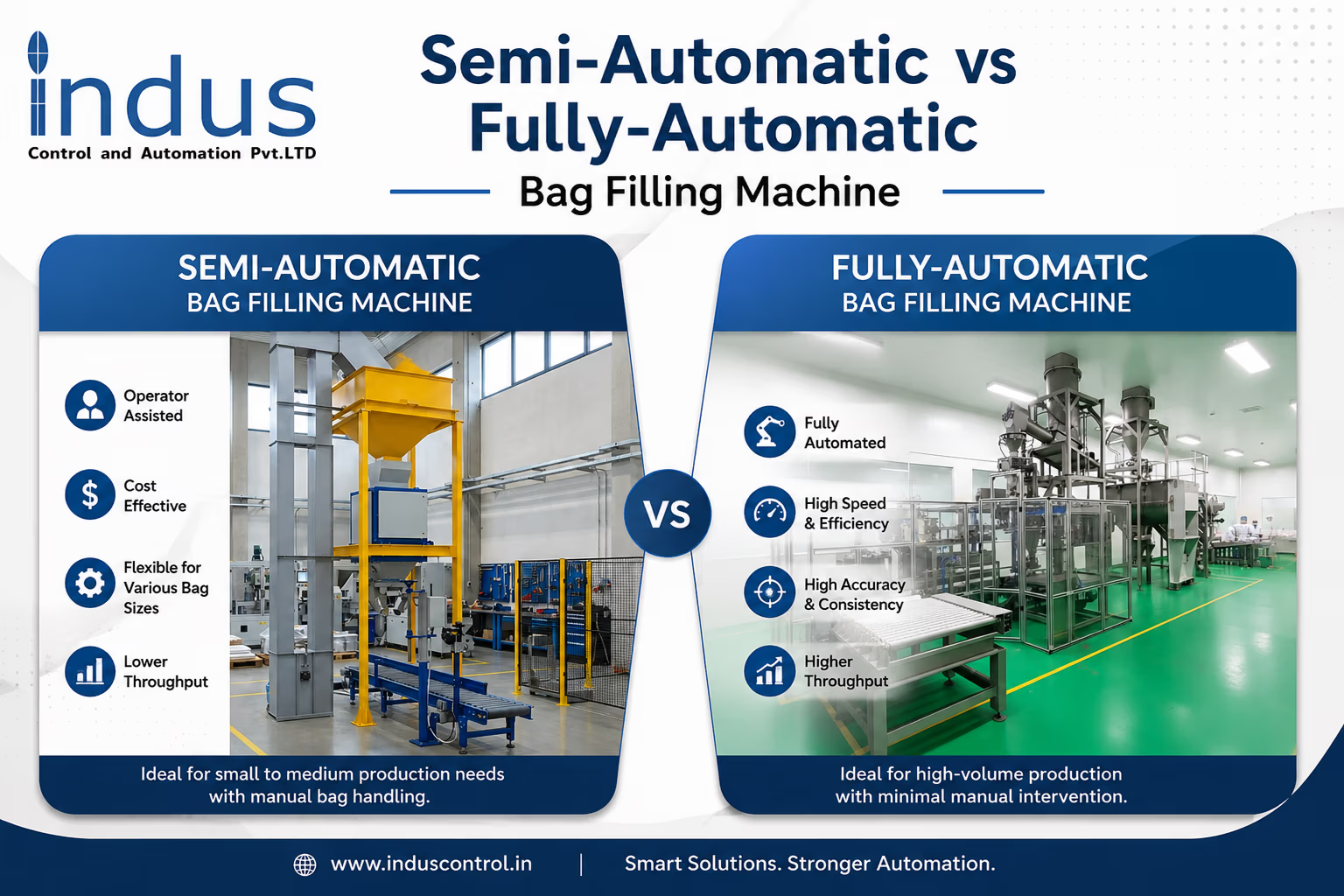
Neither option is universally “better.” A semi-automatic bag filling machine gives you precise, load-cell-based weighing while an operator still places and removes each bag. A fully-automatic system takes the operator almost entirely out of the loop, handling bag placement, filling, and sealing as one continuous sequence. Which one fits depends on your production volume, your budget, how many different products you pack, and how fast your line needs to scale.

This guide walks through exactly where the two diverge — cost, speed, accuracy, flexibility, maintenance, and floor space — and which one actually makes sense for a business that’s scaling up rather than standing still.

In this guide:

  • What each machine type actually is
  • A quick side-by-side comparison
  • Eight real differences worth weighing before you buy
  • When semi-automatic wins, and when it’s time to go fully automatic
  • Industry-by-industry fit (grains, feed, chemicals, fertilizer, cement)
  • How accuracy ties into Legal Metrology compliance in India
  • How to start semi-automatic and scale into automation later
  • FAQs

What Is a Semi-Automatic Bag Filling Machine?

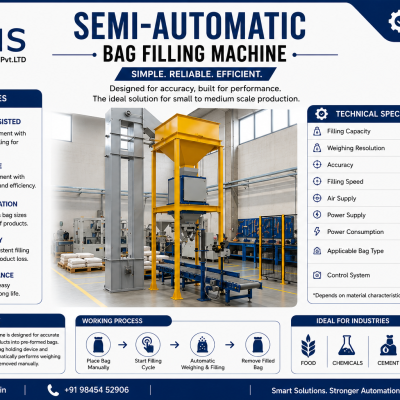
A semi-automatic bag filling machine is a weighing-and-filling system that automates the part that’s hardest to get consistently right — the weighing — while leaving bag placement and removal to a human operator. The operator positions an empty bag on the filling spout, the machine’s load-cell weighing system dispenses a precise, pre-set quantity of material, and the operator removes the filled bag for stitching or heat sealing.

That division of labor is the whole point. Weighing accuracy is where automation earns its keep, because a machine with a digital load cell and HMI controller repeats the same fill weight thousands of times without drifting. Bag handling, by contrast, is where flexibility matters most — a person can switch bag sizes, materials, or product types in minutes, something that’s far harder to automate cheaply.

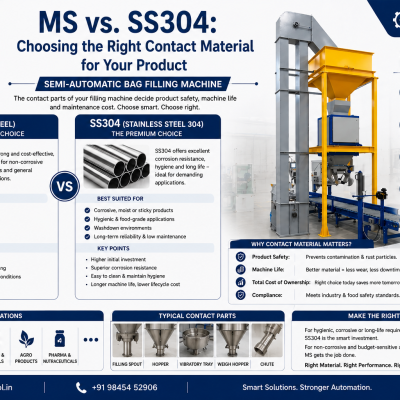
Typical semi-automatic machines in this class handle a 5 kg to 50 kg capacity range, with weighing accuracy around ±20 grams and resolution down to 10 grams, running at roughly 6 to 8 bags per minute. Controls are usually a digital weight indicator paired with an HMI touchscreen, and the machine itself is built from mild steel or SS304 for the parts that actually touch the product. That combination — strong accuracy, moderate speed, low operator skill requirement — is exactly why semi-automatic machines dominate the mid-scale packaging segment in India.

What Is a Fully-Automatic Bag Filling Machine?

A fully-automatic bag filling machine extends that same load-cell weighing system with automated bag handling on both ends. Empty bags are picked from a magazine or stack — sometimes with a robotic or pneumatic gripper — positioned under the filling spout automatically, filled, and then moved into an integrated stitching or sealing station without anyone touching the bag.

The operator’s role shifts from doing the physical work to supervising it: loading bulk bag stacks, monitoring the HMI for faults, and handling exceptions. Because the whole cycle is mechanically timed rather than paced by a person, fully-automatic lines typically run faster — often somewhere in the 15 to 25+ bags per minute range depending on configuration, material, and bag size — and can run for longer stretches with fewer people on the floor.

That speed and labor reduction comes at a cost: more actuators, more sensors, more integration points, and a bigger footprint. It’s the right investment when volume is high and consistent enough to justify it — which is exactly the trade-off the rest of this guide digs into.

Semi-Automatic vs. Fully-Automatic: Quick Comparison

FactorSemi-Automatic Bag Filling MachineFully-Automatic Bag Filling Machine
Typical capital investmentLower — a fraction of a fully automated lineHigher — bag handling, robotics, and conveyors add significant cost
Speed (indicative)~6–8 bags/minute in the 5–50 kg rangeOften 15–25+ bags/minute depending on configuration
Operators required1–2 per station, placing and removing bagsMinimal — mostly supervision and exception handling
Best-fit production volumeLow to mid-scale, seasonal, or multi-SKUHigh-volume, continuous, single or few SKUs
Changeover flexibilityHigh — manual adjustment for new bag sizes or productsLower — automated handling is often tuned to specific bag formats
Floor space neededCompactLarger — bag magazines, conveyors, and control cabinets add up
Maintenance complexityLower — fewer automated subsystems to serviceHigher — more sensors, actuators, and integration points
Typical buyerGrowing SME, multi-product plant, seasonal demandLarge-scale plant with steady, high-throughput demand

The pattern is consistent across almost every dimension: semi-automatic trades some speed for flexibility and a lower entry cost, while fully-automatic trades capital and complexity for raw throughput and reduced headcount. Neither trade-off is wrong — it depends entirely on where your business sits today.

The Real Differences, One at a Time

The table above is a fair starting point, but the decision usually comes down to a handful of factors in more depth. Here’s what actually matters once you’re comparing real quotations.

1. Capital Investment and Total Cost of Ownership

A semi-automatic bag filling machine is almost always the lower-risk first step. You’re paying for one precision subsystem — the weighing and filling unit — rather than an entire mechanized line. That matters most for businesses where cash flow, not throughput, is the binding constraint.

Fully-automatic systems cost more upfront because you’re buying bag-handling automation, often a sealing or stitching integration, and sometimes conveyors or palletizing on top of the weighing core. The total cost of ownership calculation isn’t just the purchase price, either — it includes commissioning, operator training, spare parts inventory for more complex subsystems, and (usually) a service contract. None of that is a reason to avoid automation; it’s a reason to make sure the volume is actually there to justify it before signing.

2. Production Speed and Throughput

Speed is the most obvious differentiator, but it’s worth being precise about what it actually buys you. At 6–8 bags per minute, a semi-automatic machine comfortably supports several hundred to a few thousand bags per shift, which covers a large share of mid-scale operations — cattle feed mills, regional grain packers, chemical formulators shipping in drums and bags, and construction material distributors doing sample or retail-size bagging.

Fully-automatic lines make sense once your required output consistently exceeds what one or two semi-automatic stations (and their operators) can deliver, or when you’re running near-continuous production and can’t afford operator fatigue or shift-change slowdowns to affect output. If your bottleneck genuinely is bagging speed — not upstream mixing, blending, or downstream logistics — that’s a strong signal fully-automatic pays for itself.

3. Labor: How Many People, and What They’re Doing

A semi-automatic bag filling machine typically needs one to two people per filling station: someone to place the empty bag, and often a second person to handle stitching or sealing and stacking. That’s a real, ongoing labor cost, but it’s also a source of flexibility — a trained operator adapts to a new product or bag size in minutes, with no reprogramming required.

Fully-automatic systems reduce headcount per line dramatically, sometimes to a single operator monitoring multiple lines. The labor saved is real, but it shows up as savings over time rather than immediately, and it assumes the automation runs reliably enough that “monitoring” doesn’t turn into “constant troubleshooting.” For businesses in regions where skilled automation technicians are harder to source than general labor, that’s worth factoring in honestly.

4. Weighing Accuracy and Product Handling

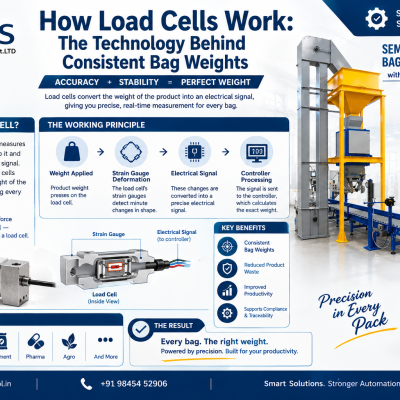
This is where a lot of buyers assume “more automated” automatically means “more accurate” — and that’s not necessarily true. Weighing accuracy is a function of the load cell, controller, and calibration, not the level of bag-handling automation around it. A well-built semi-automatic bag filling machine with a digital load cell and HMI controller can hit the same weighing accuracy as a fully-automatic one, because it’s the same weighing technology underneath.

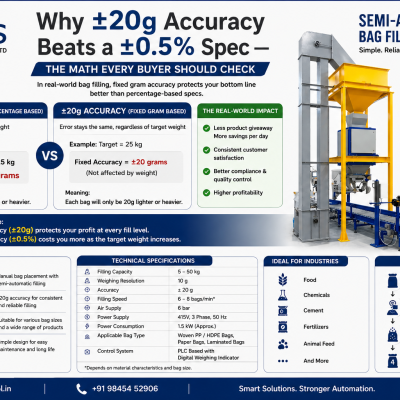
To put a number on it: a machine rated at ±20 grams absolute accuracy on a 50 kg bag is holding ±0.04% of target weight — noticeably tighter than the ±0.2% to ±0.5% accuracy several competing machines in this segment advertise for comparable capacities. On a 25 kg bag, that same ±20g spec works out to ±0.08%. The takeaway: when you’re comparing machines, ask for the accuracy in absolute grams and as a percentage of your typical bag weight — percentage-only specs can hide a wider real-world tolerance than they first appear to promise.

Product handling matters here too. Gentle, controlled feeding — whether through a screw, gravity, or belt mechanism — protects friable products like some fertilizers, food grains, and certain chemical powders from degradation during fill. That’s a design detail worth asking about regardless of automation level.

5. Flexibility Across Products and Bag Sizes

This is where semi-automatic machines genuinely have the edge. If your plant packs rice one week, cattle feed the next, and a powdered chemical the week after — or you switch between 5 kg retail bags and 50 kg bulk bags depending on the order — a semi-automatic line adapts with a weight-setting change on the HMI and, at most, a manual spout or bag-clamp adjustment.

Fully-automatic bag handling is typically engineered around a defined bag format and size range. Changing formats can mean physical retooling, not just a settings change, which is a real cost in downtime if your product mix shifts often. If multi-SKU flexibility is core to how you run the business, that’s a strong argument for staying semi-automatic even at higher volumes — or for running semi-automatic stations alongside a dedicated fully-automatic line for your highest-volume product.

6. Maintenance, Uptime, and the Skill Required to Run It

Fewer moving automated parts generally means fewer things that can fail — which is one of the underrated advantages of semi-automatic equipment. Maintenance is usually limited to the load cell, pneumatic components, and the HMI/controller, and most issues can be diagnosed and fixed by an in-house electrician or technician without specialized automation expertise.

Fully-automatic systems bring more sensors, more pneumatic or servo actuators, and more integration points between subsystems (bag magazine, filling head, sealing station, sometimes a conveyor). That’s not a flaw — it’s the cost of removing manual labor from the process — but it does mean unplanned downtime is more likely to require a specialized technician, and spare parts planning matters more.

7. Floor Space and Infrastructure

Semi-automatic machines have a compact footprint — typically just the weighing/filling frame and a small platform for the operator. That matters more than it sounds for businesses operating in rented industrial sheds or older facilities where floor space is genuinely constrained.

Fully-automatic lines need room for bag magazines, infeed/outfeed conveyors, and often a palletizing or stacking stage downstream. Beyond floor space, that usually means more compressed air capacity, more electrical load, and sometimes structural considerations for conveyor mounting — all worth pricing in before comparing headline machine costs.

8. Scalability: What Happens As You Grow

This is the question in the article’s title, and it deserves a direct answer: a semi-automatic bag filling machine is not a dead end. Most growing operations don’t jump straight from manual bagging to a fully-automatic line — they add semi-automatic stations as volume grows, run two or three in parallel to multiply throughput without the capital risk of full automation, and only move to fully-automatic once volume, product mix, and cash flow all justify it at the same time.

That staged path is lower-risk than betting on full automation before demand is proven, and it means the semi-automatic machine you buy today isn’t a step you’ll regret — it’s the first step in a scalable packaging strategy.

When a Semi-Automatic Bag Filling Machine Is the Right Call

A few situations point clearly toward semi-automatic:

  • You’re packing multiple products or bag sizes. If your line switches between rice, sugar, cattle feed, and a powdered chemical in the same week, the changeover speed of a semi-automatic setup is worth more than the raw throughput of a fully-automatic one tuned to a single format.
  • Volume is growing but not yet consistent. Seasonal businesses — agricultural inputs, certain feed products, construction materials tied to building cycles — often see demand spikes that don’t justify a fixed, high-capital automated line running below capacity the rest of the year.
  • Capital is better spent elsewhere right now. If the bottleneck in your business is upstream (mixing, blending, procurement) or downstream (logistics, distribution), pouring capital into bagging automation ahead of those constraints doesn’t move the needle.
  • You need to prove out a new product line first. Starting semi-automatic lets you validate demand and refine your packaging spec before committing to automation tuned around a specific format.
  • Skilled automation technicians are hard to source locally. Semi-automatic equipment is easier to keep running with general industrial maintenance skills, which matters in regions where specialized service is a longer drive away.

When It’s Time to Go Fully Automatic

The case for fully-automatic gets stronger, and eventually decisive, when:

  • Bagging is your actual bottleneck. If upstream production can supply more than your bagging stations can package, and that gap is costing you orders, automation pays for itself in throughput alone.
  • You’re running one or two dominant SKUs at high, consistent volume. Fully-automatic bag handling is most efficient when it’s tuned to a narrow, predictable format — exactly the profile of a plant that’s matured past a broad, multi-product mix.
  • Labor cost or availability is a growing constraint. In markets where skilled bagging-line labor is increasingly expensive or hard to retain, reducing headcount per line changes the economics meaningfully over a multi-year horizon.
  • You need multi-shift, near-continuous operation. Automated lines don’t fatigue, and they don’t slow down at shift change — a real advantage for plants running close to 24/7.
  • You’ve already proven the demand. This is the natural next step after a period of scaling on semi-automatic equipment, once volume and product mix have stabilized enough to justify tuning a line around them.

Industry-by-Industry: Which Fits Better?

The right answer also shifts depending on what you’re actually packing:

Food grains (rice, wheat, sugar, dal, pulses). Multi-SKU, multi-bag-size operations are common here, and product gentleness matters — a controlled semi-automatic feed mechanism reduces breakage and dust generation. Most mid-scale grain packers stay semi-automatic well into meaningful volume, moving to fully-automatic only for their highest-volume single product.

Animal feed (cattle feed, poultry feed, fish meal). Feed mills often run several formulations and bag sizes through the same line. Semi-automatic flexibility tends to win here unless a single formulation dominates output.

Chemicals (powdered chemicals, minerals, additives). Accuracy and dust control matter more than raw speed for most chemical bagging operations, and product-specific handling requirements (moisture sensitivity, particle size) often make a flexible, well-controlled semi-automatic setup the safer choice — with a dust extraction hood as a near-essential accessory.

Fertilizers (granular and powdered). Higher-volume fertilizer operations, especially those tied to a single dominant formulation and a defined bagging season, are among the strongest candidates for fully-automatic lines — provided the seasonal peak volume justifies the fixed investment.

Construction materials (cement, sand, plaster). Cement bagging at scale is a classic fully-automatic use case for high-volume plants. But sample bagging, smaller-batch runs, or plaster and specialty blends in variable bag sizes are exactly where a semi-automatic machine remains the more practical choice — which is why you’ll find semi-automatic equipment running cement sample bagging even at large cement manufacturers.

Compliance Note: Accuracy and Legal Metrology

For any business packaging goods for retail or general sale in India, weighing accuracy isn’t just an operational concern — it’s a regulatory one. The Legal Metrology (Packaged Commodities) Rules, 2011 govern declared net quantity accuracy for pre-packaged commodities sold in India, with defined sampling and tolerance-checking procedures for verifying that declared weight matches actual fill weight.

It’s worth knowing the rules don’t apply uniformly to every bag size: packages above 25 kg generally fall outside the standard Packaged Commodities Rules, and cement, fertilizer, and agricultural produce sold in bags above 50 kg — along with packaging meant purely for industrial or institutional consumers — are specifically exempted. In practice, that means smaller consumer-facing bags (retail rice, sugar, pulses) carry the strictest accuracy expectations, while bulk industrial and large-format bags have more room. Either way, a machine with tight, well-calibrated accuracy — semi-automatic or fully-automatic — makes compliance a non-issue rather than a recurring risk.

Making the Transition: Start Semi-Automatic, Scale Into Automation

For most growing manufacturers, the practical path isn’t “semi-automatic or fully-automatic” — it’s semi-automatic first, with a clear runway to automate later. A few things make that transition smoother when the time comes:

  • Choose a machine built on the same weighing technology fully-automatic systems use. A quality load cell and digital controller don’t get thrown away when you automate bag handling later — they’re often the same core components a fully-automatic upgrade builds around.
  • Standardize your bag formats early where you can. Even partial standardization makes a future automated bag-handling system easier and cheaper to specify.
  • Track your actual bags-per-shift and downtime data from day one. That operating history is exactly what justifies (or rules out) the capital case for automation later — and most Indian packaging machinery buyers underinvest in this simple habit.
  • Buy from a manufacturer who builds both. A supplier offering both semi-automatic and fully-automatic bag filling machines — like Indus Control and Automation’s semi-automatic and fully-automatic product lines — can spec your current machine with an eye on what a future upgrade would actually require, rather than treating it as a one-off purchase.

India’s packaging machinery market was valued at roughly USD 2 billion in 2025, and industry analysts expect steady growth through the rest of the decade as food processing, e-commerce, and manufacturing output continue to expand. That growth is being driven disproportionately by mid-scale manufacturers automating in stages — which is exactly the semi-automatic-first pattern described above, not a one-time leap to full automation.

Making the Decision: A Simple Framework

If you’re still weighing the two, three questions cut through most of the noise:

  1. Is bagging your actual production bottleneck today — not a theoretical one, but the thing genuinely limiting output right now? If not, a fully-automatic line’s speed advantage goes unused.
  2. How many products and bag sizes run through this line in a typical month? More than two or three formats is a strong vote for semi-automatic flexibility.
  3. Can current volume justify the higher fixed cost of full automation without idle capacity? If volume is still building, a semi-automatic machine — or two running in parallel — usually delivers a better return than one underused automated line.

Answer those honestly, and the right choice is usually clear well before you request a formal quotation.

There’s no universal winner between semi-automatic and fully-automatic bag filling machines — only the right fit for where your business is today and where it’s headed over the next few years. A semi-automatic bag filling machine gives growing, multi-product operations precise weighing, low capital risk, and the flexibility to adapt as demand shifts. A fully-automatic system earns its higher cost once volume, product consistency, and labor economics all point the same direction.

Indus Control and Automation builds both, with semi-automatic bag filling machines already running cattle feed lines at Malganga Dairy, protein powder packaging at Punit Proteins, cement sample bagging at Ultratech Cement, food grain packaging at BhagyaLaxmi Industries, and dairy product packaging at Verka — a real spread of industries and bag formats on the same underlying platform. If you’re weighing this decision for your own line, a live demonstration with your actual product is the fastest way to see which fit makes sense.


Frequently Asked Questions

What is the main difference between semi-automatic and fully-automatic bag filling machines?

A semi-automatic bag filling machine automates the weighing and filling process but relies on an operator to place and remove each bag. A fully-automatic machine also automates bag placement, filling, and sealing, needing only supervision rather than hands-on operation.

Is a semi-automatic bag filling machine accurate enough for industrial use?

Yes. Weighing accuracy depends on the load cell and controller, not the level of bag-handling automation. A well-built semi-automatic bag filling machine can match the weighing precision of a fully-automatic system — machines rated at ±20 grams accuracy are common and comply comfortably with typical industrial and Legal Metrology requirements.

How many workers are needed to operate a semi-automatic bag filling machine?

Most semi-automatic setups run with one to two operators per station — one to place and remove bags, and often a second for stitching or sealing. That’s more labor than a fully-automatic line, but it comes with far greater flexibility to switch products and bag sizes quickly.

Can a semi-automatic bag filling machine be upgraded to fully automatic later?

Not as a simple retrofit in most cases, but choosing a semi-automatic machine built on the same load cell and control technology used in fully-automatic systems makes a future transition far more straightforward, since the core weighing components carry over conceptually even if the machine itself is replaced or expanded.

Which is more cost-effective for a small or mid-scale business?

For most small and mid-scale operations, a semi-automatic bag filling machine offers the better return: lower upfront investment, flexibility across multiple products, and a speed (typically 6–8 bags per minute) that comfortably covers demand until volume genuinely outgrows it.

What bag weight range can a semi-automatic bag filling machine handle?

Standard semi-automatic machines in this category typically cover a 5 kg to 50 kg capacity range, making them suitable for everything from retail-size food grain bags to bulk cattle feed, fertilizer, and construction material bags.

Which industries benefit most from semi-automatic bag filling machines?

Food grains, animal feed, chemicals, and fertilizers all benefit from semi-automatic flexibility, especially where multiple products or bag sizes run through the same line. Construction materials like cement typically move to fully-automatic at very high volumes, but semi-automatic remains the practical choice for sample bagging and smaller-batch runs even at large plants.

Previous Post

Leave a Reply

Your email address will not be published. Required fields are marked *

We are Indus Control. Built on Precision. Driven by Purpose.

Industrial automation solutions – weighing, bagging, packing, and palletizing – delivered with international quality at Indian prices.

Follow Us

Navigation Links

Company