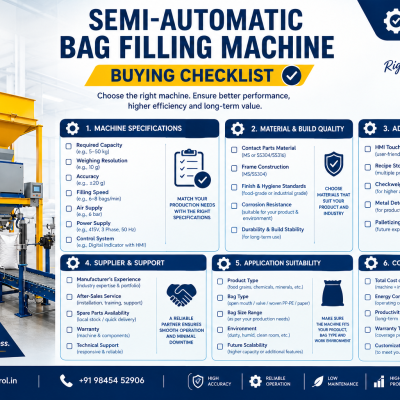
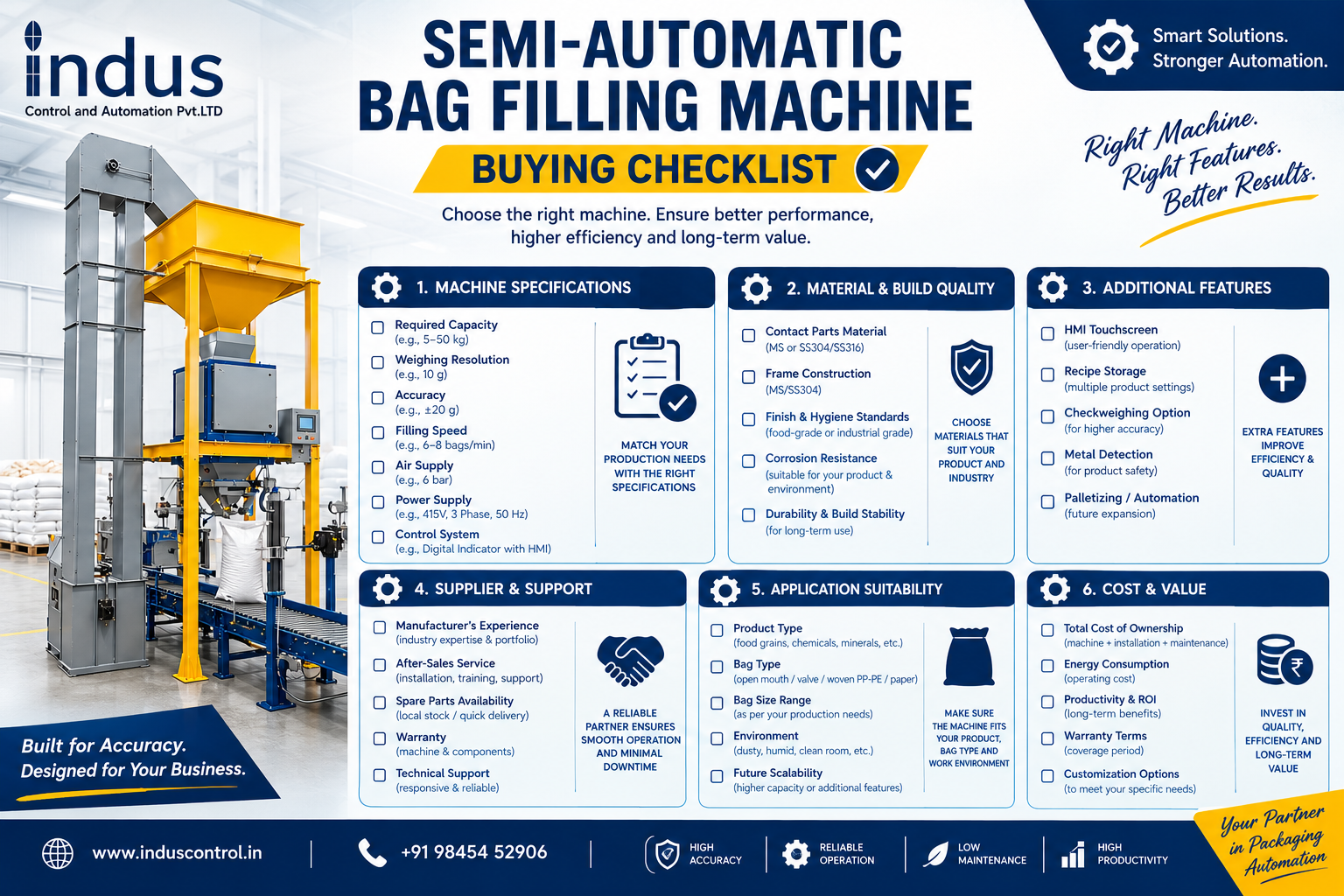
A quote looks simple. It shows one machine, one price, and one delivery date. But the details behind that quote decide how your line runs for years. This bag filling machine checklist gives you 12 questions to ask before you order.
Most buyers compare two numbers: price and capacity. Those numbers say little about accuracy, material fit, or service. They also hide what happens when a part fails in month six. A fair comparison needs more. It needs the same questions, asked of every supplier.
Ask these questions before you sign, not after the machine arrives. Each one links to a deeper guide, so you can learn more when you need it. Every question also guards against a common and costly mistake.
In this checklist:
- Five facts to gather before you start
- The 12 questions, in the order to ask them
- Red flags to watch for in the answers
- What happens when buyers skip a question
- How to compare quotes fairly
- FAQs
Why You Need a Bag Filling Machine Checklist
A spec sheet shows one maker’s numbers. Those numbers don’t tell you what they mean for your product. Nor do they show how they compare with the quote on the next desk.
A checklist solves that problem. You ask every maker the same 12 questions, in the same order, with the same words. Then you get answers you can compare. You trade sales copy for facts.
Two machines can share almost the same spec sheet. Still, they can behave very differently on your floor. The right questions show that gap early. Sales sheets exist to sell machines. A written answer to a sharp question is much harder to dodge. That is why a bag filling machine checklist works better than a sales sheet.
Before You Start: Gather Five Facts
Good answers need good inputs. Collect these facts before you contact any maker:
- Your product. Note its name, grain or powder size, moisture level, and dust level.
- Your bag range. List the smallest and the largest bag you fill.
- Your output. Count the bags you fill in a normal shift.
- Your site. Write down your voltage, phase, and compressed air supply.
- Your wish list. Note any add-ons, such as a dust hood or a sealing unit.
Share the same facts with every maker. Then every quote starts from the same base.
The 12 Questions to Add to Your Bag Filling Machine Checklist
Work through the bag filling machine checklist in order. Each answer shapes the next one.
1. What Is Your Real Bag Weight Range?
Start with your own numbers, not the machine’s. Write down the smallest and the largest bag you fill. Don’t round up “just in case.”
A machine rated for 5–50 kg covers a wide span. Narrow ranges often hold a smaller margin of error inside their band. That trade-off matters, so know where you sit.
Many buyers ask for more range than they will ever use. That habit adds cost and gives nothing back. If you only fill 25 kg and 50 kg bags, say so. Then every supplier can price the right machine for you. Your bag range also shapes every other answer on the list, so get it right first.
A good answer: The maker asks for your range, then offers the machine that fits it best.
2. How Accurate Must It Be, in Grams?
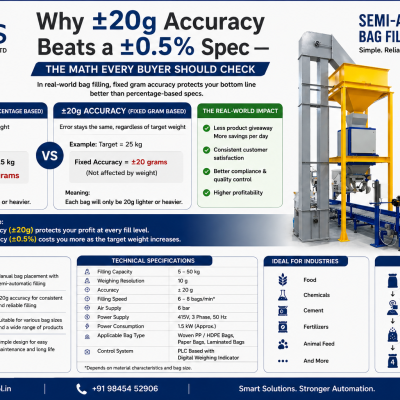
Ask for accuracy in grams, not only as a percentage. A percentage means one thing on a 5 kg bag and another on a 50 kg bag. You can’t compare two machines until you convert both figures.
Here is a quick example. A ±0.5% claim on a 10 kg bag equals ±50 g. The same claim on a 40 kg bag equals ±200 g. That is four times looser, yet the percentage looks identical.
So convert every quote to grams at your own bag weight. Then compare them. Our accuracy guide shows the full math. If you sell small retail packs, India’s rules for packed goods may also apply to you. Tight accuracy helps you stay inside them.
A good answer: You get a gram figure for your own bag weight, such as “±20 g at 25 kg.”
3. Does the Quote List Resolution and Accuracy Separately?
These are two different numbers, and people mix them up often. Resolution is the smallest step the display can show. Accuracy is how close the real fill lands to your target.
A screen can show single grams and still miss the target by far more. That gap is why you need both figures. If a maker gives only one, you see half the picture.
So ask which number you are reading. Then ask for the other one. A good maker answers in seconds. Indus, for example, lists a 10 g resolution and a ±20 g accuracy on separate lines.
A good answer: The quote shows both numbers and explains how the maker tests each one.
4. What Load Cell Certification Does It Carry?
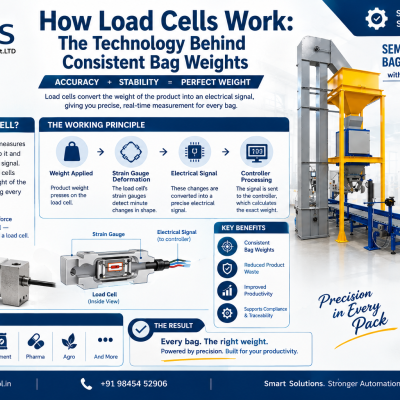
The load cell is the part that weighs your product. A good one carries an OIML R60 certificate with a stated accuracy class. This one question weeds out many vague answers.
If a seller can’t name the class, ask why. Makers that buy approved parts answer fast, because the proof already sits in their files. Words like “high accuracy load cell” tell you nothing. A class tells you a lot. Ask to see the certificate itself, not just hear the class named.
Want to know why this matters? Read how load cells work. The guide shows what sets a steady load cell apart from a weak one.
A good answer: The maker names the class, shows the certificate, and says who made the cell.
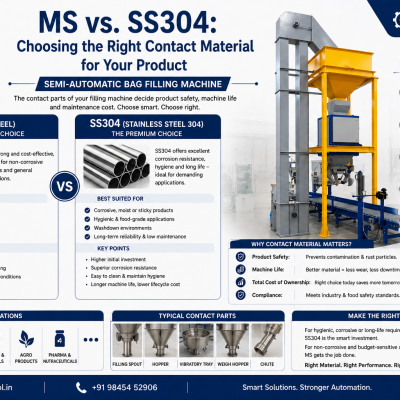
5. Should the Contact Parts Be MS or SS304?
Choose by product, not by budget. Dry goods that can’t rust the machine run well on mild steel (MS) for years. Food, damp chemicals, and anything under food-safety rules usually need SS304 wherever the product meets the machine.
Don’t pay extra out of fear. Picking the cheaper one just to save money is also a mistake.
Ask about a hybrid build as well. It uses SS304 only on the parts that touch the product, and MS for the frame. Many quotes skip it unless you ask. Our MS vs SS304 guide explains how to decide. It also shows how to check that “SS304” really is SS304.
A good answer: The quote names the grade, offers a hybrid option, and explains why your product needs it.
6. How Fast Must It Run?
Bags per minute matters, but only against your real target. A machine built for a speed you never use adds cost and no value.
Start with your current shift output. Then add reasonable room to grow. Don’t size the machine for a forecast you may never hit. Check the speed again in a year.
Semi-automatic machines suit a steady, mid-size line. Indus machines, for example, fill about 6 to 8 bags a minute. If you need far more, read our guide to semi-automatic vs fully automatic machines. You can also run two stations side by side.
A good answer: The maker links speed to your product, because fine powder often fills slower than free-flowing grain.
7. Which Add-Ons Do You Need?
Add-ons come as separate line items. They include a printer link, PC data logging, and SMS alerts. Others cover a bag flattener, a dust hood, and a stitching or sealing unit. Don’t assume any of them come standard.
List what you need before you ask for a quote. Be specific. Then every quote covers the same package. Without a list, you may compare a bare machine from one maker with a fully loaded machine from another.
Plan ahead, too. Adding a part later often costs more than ordering it now. Sometimes the part doesn’t fit well once the machine stands on your floor.
A good answer: Each add-on gets its own line, so you can drop the ones you don’t need.
8. What Power and Air Supply Do You Have?
Confirm your voltage, phase, and compressed air before you order. Do it before the machine arrives, not after. A mismatch delays setup, and that delay has nothing to do with machine quality.
Most makers can adapt a machine to your supply. They can only do that if you give exact details. Indus machines, for example, run on 415 V, three-phase, 50 Hz power and 6 bar of clean, dry air. Other setups are possible on request.
Don’t leave this for the start-up visit. Put your supply details in your written order.
A good answer: The maker asks for your readings first, then confirms the machine fits them.
9. Does the Quote List Each Cost?
Ask every maker to list the base machine, add-ons, setup, and service terms on separate lines. One lump sum tells you almost nothing about what you pay for.
A line-by-line quote lets you compare makers fairly. It also shows who adds real value and who pads the total. Our guide to what drives bag filling machine cost shows what each line should cover.
Watch for gaps, too. If one quote lists setup and another doesn’t, the second one isn’t cheaper. It’s just incomplete.
A good answer: Each line says what it covers, so nothing hides inside a total.
10. What Does Installation Cover?
Site prep, power links, air hookup, and a start-up test sometimes come with the machine. Sometimes they don’t. Confirm which in writing before you order.
Buyers often assume the quote covers these costs. Then they find the gap after delivery, and they negotiate from a weak spot. Ask early and you keep your bargaining power.
Go one step further. Ask who does each task: your team, the maker’s team, or a third party. A clear answer now prevents a long argument later. Also ask how long setup takes and how many days of operator training you get.
A good answer: The quote says who does what, and it gives a start-up date.
11. What Do the Warranty and Service Plan Cover?
Ask how long the warranty lasts and what it covers. Then ask whether a yearly service plan exists. Spare part supply matters as much as the warranty itself.
A cheaper machine with weak support often costs more over time. Stopped lines cost money, even when the purchase was cheap. So weigh support as seriously as you weigh price.
Finally, ask how fast an engineer can reach your site. A promise of “quick service” means little without a number. Look for a stated response time and a local stock of spare parts.
A good answer: The quote states the warranty length, the scope, and the response time in writing.
12. Can You Test It With Your Own Product?
This question catches what the first eleven miss. Live tests with your real material show true accuracy, true speed, and true product flow. A generic sample can’t do that.
Watch how the machine copes with your product’s quirks, such as density, flow, moisture, and grain size. Fine powder and sticky feed can behave very differently from clean test material. Also compare the first bag with the hundredth. They should match.
A confident maker welcomes the test. Indus, for example, offers a live demo at its Bangalore facility and an on-site trial with your own samples. If a maker delays or resists, treat that as information. Every good bag filling machine checklist ends with this step.
A good answer: The maker offers a date, asks for your samples, and shares the test results.
Red Flags Your Bag Filling Machine Checklist Can Catch
Some answers to your bag filling machine checklist should slow you down, however good the price looks. Watch for these:
- Percent only. Accuracy appears as a percentage, with no gram figure even when you ask.
- No certificate. The load cell answer is “high accuracy” instead of an OIML class.
- Vague steel. “Stainless steel” appears with no grade. Ask for the grade in writing.
- One lump sum. You ask twice for a line-by-line quote and still get one number.
- No live test. The seller avoids running your own product.
- Fuzzy warranty. Terms say “standard warranty” with no length or scope.
- Setup “usually included.” No one will confirm it for your order.
None of these flags means a seller is dishonest. Some sellers simply haven’t faced these questions before. Even so, a clear, specific answer beats a smooth, vague one every time. Trust the detail, not the tone.
What Happens When Buyers Skip the Bag Filling Machine Checklist
Every unasked question on your bag filling machine checklist leads to a real problem later. Here are the most common ones.
Problems With Accuracy and Cost
- A missed gram conversion can leave you with a wider margin of error than you expected. The machine then gives away product through overfill, month after month.
- Without the load cell question, you have no way to check the accuracy claim.
- A wrong material choice has two bad outcomes. You either overpay for steel you didn’t need, or mild steel rusts on a product that needed SS304.
Problems With Setup and Support
- Without a line-by-line quote, comparing offers turns into guesswork.
- Assuming the quote covers setup can stall a project over a power link nobody budgeted.
- A vague warranty turns the first breakdown into a negotiation.
- Skipping the live test means a late surprise. You learn how the machine copes with your product only after it stands on your floor. That is the costliest place to find out.
None of these problems shows up on day one. They show up in month three, month six, or during your first busy season. That is when you have the least patience. Asking costs a few minutes. Finding out later costs far more.
How to Use Your Bag Filling Machine Checklist to Compare Quotes
A bag filling machine checklist only works if you use it the same way every time.
Send the Same Questions to Everyone
Send all 12 questions to every maker on your list. Use the same words each time, and put them in writing. That stops makers from answering different questions. It also makes their answers easy to compare side by side.
Three makers are usually enough. Fewer may miss a better option. More adds work without adding insight.
Score and Save the Answers
Score each answer, not just the final price. A maker who answers all 12 clearly shows you how it will treat you after the sale. Vague answers are worth noticing before you commit.
Keep the written answers. If the machine later falls short of a written answer, you hold proof. A simple sheet helps: one row per question, one column per maker. That sheet turns this bag filling machine checklist from a chat into a real decision tool.
Final Thoughts on the Bag Filling Machine Checklist
Twelve questions won’t slow down a good maker. A team that knows its machine answers on accuracy, load cells, material, and service without a pause. The answers already sit in its files.
Indus Control and Automation builds semi-automatic bag filling machines for 5 to 50 kg bags. They combine load cell weighing, an HMI touchscreen, and MS or SS304 construction. Quotes follow your material and output needs. Bring this bag filling machine checklist to your next meeting with any seller, including us. It’s the fastest way to tell a machine that fits your line from one that only fits a price.
Ready to see it work? Explore the semi-automatic bag filling machine and book a live demo with your own product samples.
Bag Filling Machine Checklist FAQs
What is the most important question on this bag filling machine checklist?
Question 12 matters most. Testing with your own product shows real accuracy, speed, and flow. Spec sheets only describe what a machine should do. A live run shows what it does.
Should I use this bag filling machine checklist for a small purchase?
Yes. A small buyer has less room for a stopped line or a bad fill. That makes these questions matter more, not less. The size of the order doesn’t change the risk of a poor match.
How many makers should get the bag filling machine checklist?
Three is usually enough to see real differences. Fewer may hide a better option. More adds effort without much extra insight.
What if a maker can’t answer some of the questions?
Treat that as useful information. A maker that can’t state accuracy in grams may be new to this field. The same goes for one that can’t name a load cell class or break down a quote. Either way, you learn it before you order, not after.
Should I send the questions in writing?
Yes. Written questions get more careful answers than a quick call does. They also give you a record. If the machine later misses a written answer, you can point to it.
How long should a maker take to answer the bag filling machine checklist?
Expect a few working days. The answers already sit in the maker’s records. A long delay on simple technical questions is a signal in itself.
Do I need technical skills to judge the answers?
No. The questions use plain terms, and a good maker explains each answer simply. If something confuses you, ask for it in writing. Then show it to a trusted engineer or to a customer who runs the same machine.
What should I do after I get the answers?
Score each answer, then shortlist the top two makers. Book a live test with each one. Compare the test results with the written answers. Pick the maker whose machine matches what it promised.
Can I add my own questions?
Yes. Add questions about your product, your plant, or your local rules. Keep the 12 as your core, so you can still compare every maker fairly.
Does this bag filling machine checklist work for fully automatic machines?
Mostly, yes. Questions on accuracy, load cells, material, setup, and warranty apply to both types. A fully automatic line adds a few more, such as bag handling and links to other equipment. Ask those on top of this bag filling machine checklist, not instead of it.
Can I use this bag filling machine checklist to replace an old machine?
Yes, and it helps even more. A replacement gives you a chance to fix what the old machine got wrong. Perhaps its accuracy was always looser than promised. The steel may have rusted early. Service may never have shown up. Use the checklist to probe those exact gaps.
Is it fair to ask for customer references?
Yes, and it pairs well with this bag filling machine checklist. Written answers tell you what the maker claims. A customer who runs the same machine tells you whether the claim held up over months of real use.
Does the bag filling machine checklist change by industry?
The structure stays the same, but the weight of each question shifts. Food and feed buyers should press hardest on material and accuracy. Cement and construction buyers usually care more about speed and durability. Chemical buyers should push on material fit and dust control. Use all 12 questions, but expect your own priorities to shift.