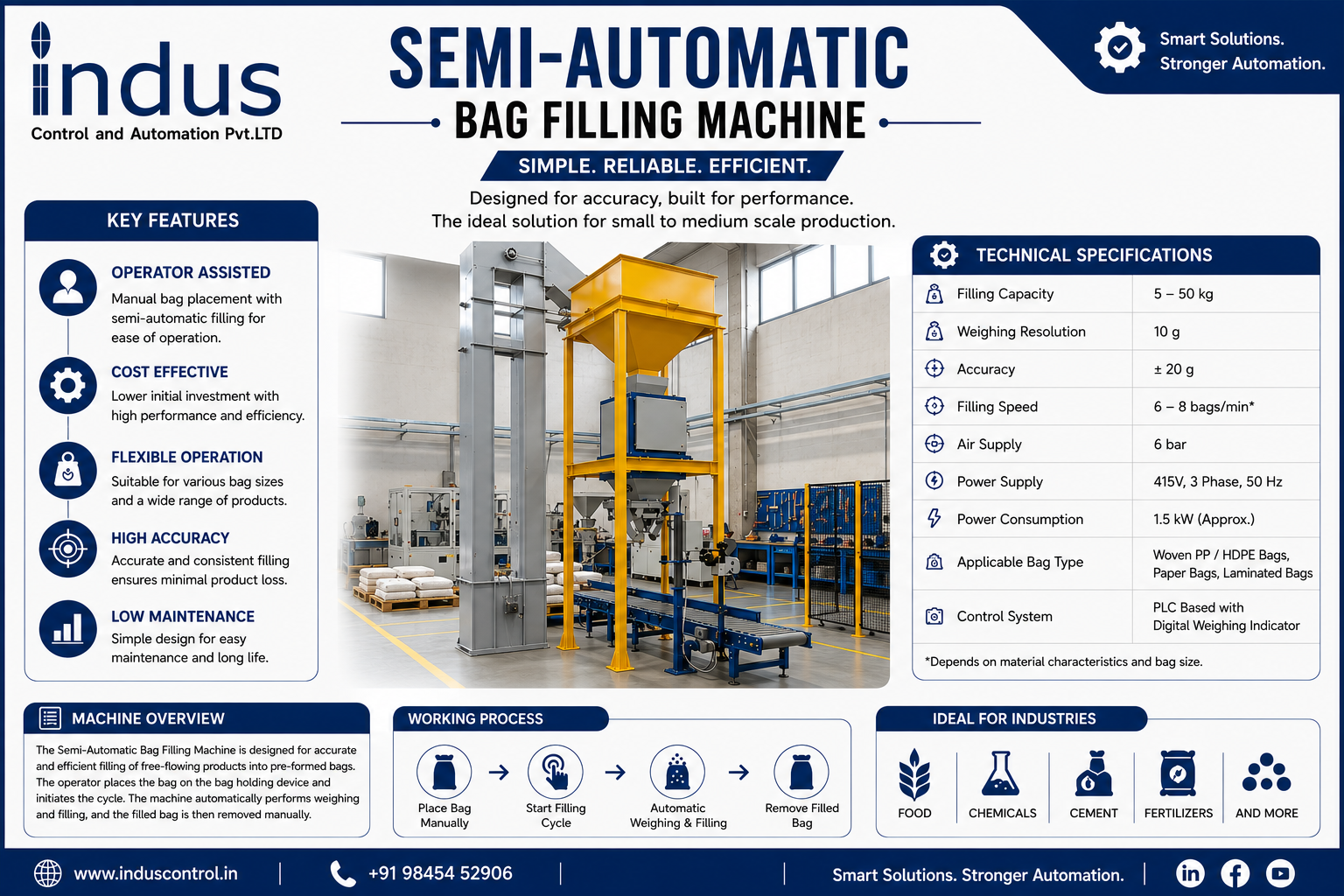
Understanding Bag Filling Machine Pricing in India
“What is the price of a bag filling machine?” is a very common question in the packaging category.
However, no honest manufacturer can answer with a single number.
A bag filling machine price in India varies widely across machines that look similar on a spec sheet. That price difference is not driven by the machine category alone.
Instead, a dozen smaller choices inside the spec sheet determine the overall cost.
This guide explains what moves a bag filling machine’s price up or down.
When you request a quotation, you can understand what you pay for and compare quotes accurately.
In This Guide:
- Why a single “bag filling machine price” does not exist
- Core factors that drive equipment cost
- Hidden costs buyers often miss
- How GST, materials, and imported components affect 2026 pricing
- Why the cheapest quote is rarely the best value
- How to request an accurate, side-by-side quotation
- Frequently asked questions
Why There Is No Single “Bag Filling Machine Price”
Search for bag filling machine prices in India and you will see widely different numbers across supplier listings.
Even machines that appear to do the same work have large price spreads.
This difference does not mean manufacturers are inconsistent. Instead, it shows how customized industrial packaging equipment is.
Two semi-automatic machines can differ in weighing accuracy, construction material, speed, controller features, and optional attachments.
For instance, a machine built for 5–10 kg feed bags with a mild steel frame and manual settings is completely different from a 50 kg SS304 unit with dust control and PC logging features.
Yet, both machines fall under the same product category.
Therefore, published price lists are rarely helpful on their own. They answer what the cheapest model costs, but fail to answer what your specific setup costs.
Understanding individual cost factors helps you evaluate real equipment prices.
Core Cost Drivers
Every quotation represents a combination of engineering decisions.
Understanding these factors helps you read quotes intelligently and compare options fairly.
1. Capacity Range and Weighing System
Target weight ranges determine structural frame size, load cell size, and feed mechanisms.
A machine built for 5 kg to 50 kg bags requires simpler mechanics than a 500 kg to 1.5-ton jumbo bag system.
Over-specifying capacity “just in case” quietly increases costs for headroom you may never use. Size your machine for your actual production needs rather than future goals.
Capacity width also matters. Holding accuracy across a wide span (5 kg to 50 kg on one machine) requires specialized load cells and calibration routines.
If your product mix covers a wide range, paying for flexibility makes sense. If you run one or two standard bag sizes, choosing a narrower range is more cost-effective.
2. Automation Level: Semi-Automatic vs. Fully Automatic
Automation level serves as the largest price driver.
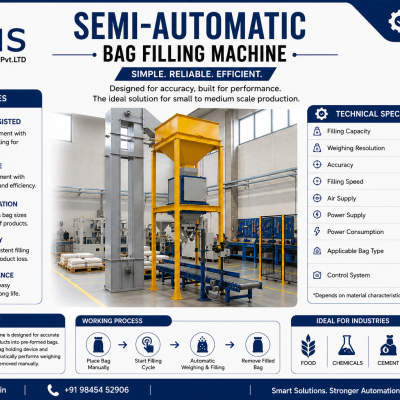
A semi-automatic bag filling machine handles weighing and filling while an operator places and removes bags.
A fully automatic system adds automatic bag feeding, bag placement, and integrated sealing subsystems. These automated handling features increase total machine cost significantly.
3. Weighing Accuracy and Load Cell Grade
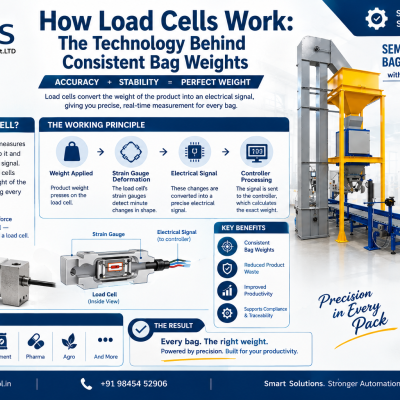
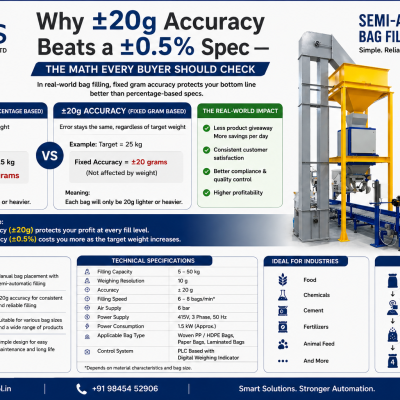
High weighing precision requires certified, higher-grade load cells and advanced digital filtering.
When selling products by net weight under Legal Metrology rules, precise weighing protects profit margins.
Paying for higher accuracy earns back its cost over time by reducing extra product giveaway.
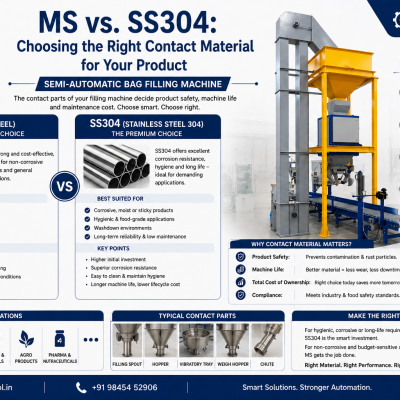
4. Construction Material: Mild Steel vs. SS304
Material choice affects raw component costs and manufacturing time.
Mild steel (MS) costs less and suits non-food, non-corrosive products like construction materials and fertilizers.
SS304 stainless steel resists rust and meets food-grade hygiene standards, but carries a higher material cost.
Furthermore, SS304 requires specialized welding and surface polishing to meet food safety standards, adding fabrication labor.
You can also request a hybrid configuration—using SS304 for product contact parts and mild steel for the frame—to optimize costs.
5. Speed and Throughput Requirements
Higher bags-per-minute targets demand faster feed mechanisms, high-speed pneumatics, and responsive controllers.
Building a machine to sustain high speeds without weight drift requires extra engineering.
Specify speed based on actual production data rather than best-case goals to keep costs reasonable.
6. Controller and HMI Features
Basic digital weight indicators cost less than touchscreen HMI controllers with recipe memory and data logging.
A simple controller works well for single-product packaging lines.
For multi-product plants that change settings often, an advanced HMI saves time during product changeovers.
7. Optional Accessories and Integrations
Optional accessories create wide variations between quotes. Common additions include:
- Printer interfaces for weight slips
- PC connections for data logging
- SMS alerts for remote updates
- Bag flatteners and tilters
- Dust extraction hoods
- Integrated bag sewers or heat sealers
List needed accessories explicitly in your inquiry so quotes reflect your final operational setup.
8. Customization and Engineering Time
Standard machine builds cost less than custom units engineered for non-standard bags, fine powders, or abrasive products. Customization reflects engineering labor needed to handle specific materials correctly.
9. Brand, Technical Support, and Warranty
Two identical spec sheets may carry different prices based on supplier support:
- In-house engineering versus outsourced fabrication
- Warranty coverage and local spare parts availability
- Quality of after-sales service and commissioning support
A lower-cost machine with limited support can lead to costly downtime later.
How Cost Drivers Differ by Industry
Industry requirements shift which cost factors matter most:
- Food Grains (Rice, Wheat, Sugar, Pulses): Food-safety rules require SS304 contact parts and gentle handling mechanisms to prevent grain breakage.
- Animal Feed (Cattle Feed, Poultry Feed, Fish Meal): Multiple formulas make wide capacity ranges and versatile controllers valuable. Mild steel frames remain standard.
- Chemicals (Powdered Chemicals, Additives, Minerals): Dust extraction hoods and corrosion-resistant materials are essential. High dosing accuracy is also critical.
- Fertilizers (Granular and Powdered): High seasonal packaging volumes make reliability and high speed top priorities over multi-product flexibility.
- Construction Materials (Cement, Sand, Plaster): High throughput and wear-resistant materials dominate full-scale plants. Sample bagging lines use simpler, low-cost units.
Hidden Costs Buyers Often Miss
The machine quote represents only part of your initial setup investment. Remember to consider these hidden expenses:
- Installation and Commissioning: Check whether site setup, electrical wiring, and plumbing connections are included in the quote.
- Operator Training: Factor in time and effort to train operators properly on new equipment.
- Freight and Logistics: Delivery costs vary based on machine dimensions and transport distance.
- Service Contracts and Spare Parts: Plan budget allocations for routine maintenance and replacement components.
- Downtime Costs from Under-Specifying: Choosing an underspecified machine leads to product giveaway, rework, and lost production.
- Calibration and Compliance: Products governed by Legal Metrology rules require ongoing scale verification.
Economic and Regulatory Factors in 2026
External market factors shape equipment costs across India:
- GST Treatment: Packing and filling machinery (HSN Chapter 84) carries an 18% GST rate. Registered businesses can claim this tax as an Input Tax Credit.
- Raw Material Prices: Global steel prices for mild steel and SS304 stainless steel impact structural fabrication costs.
- Imported Components: Load cells, PLCs, and HMI panels are subject to exchange rates and import duties. Local structural fabrication helps insulate overall costs.
- Business Financing: Equipment loans via banks, NBFCs, and government programs like CGTMSE provide financing options for eligible MSMEs.
Why the Cheapest Quote Is Rarely the Best Value
Selecting the lowest initial price tag does not ensure long-term value.
Measure machine costs by evaluating total cost per accurately filled bag over the equipment’s service life.
An underspecified machine causes product giveaway by overfilling bags to prevent underweight risks. Weak feed controls damage delicate products, leading to extra rework.
Inadequate supplier support can turn minor component faults into long production delays.
Evaluating accuracy specifications, build quality, and warranty coverage ensures better value over time.
How to Get an Accurate, Comparable Quotation
To compare supplier quotes fairly, provide the same detailed brief to every manufacturer:
- Product details: Material type, moisture content, abrasiveness, and dust level.
- Bag weight range: Exact minimum and maximum bag weights.
- Required accuracy: Tolerances expressed in precise grams.
- Target speed: Bags-per-minute requirements.
- Material preference: Mild steel or SS304 specifications.
- Power and air supply: On-site voltage, phase, and compressed air capacity.
- Accessories needed: Printers, dust hoods, sealers, or bag flatteners.
- Site readiness: Installation timeline and physical floor space.
Ask manufacturers to itemize base machinery, optional accessories, delivery, installation, and warranty terms separately.
Conclusion
A single price number cannot describe bag filling equipment accurately.
Equipment pricing depends on capacity, automation level, precision, materials, speed, controllers, accessories, and engineering support.
Indus Control and Automation manufactures semi-automatic and fully automatic bag filling machines tailored to your specifications.
Contact our team with your product specs and speed targets to receive an itemized, apples-to-apples quotation!
Frequently Asked Questions
Why are bag filling machine prices not published online?
Prices depend on capacity, materials, accuracy, speed, and accessories. Published figures often list bare-minimum setups or force buyers into fixed configurations.
What information is required to get an accurate quote?
Provide your product type, bag weight range, target speed, accuracy requirements, preferred materials, utility power, and accessory preferences.
Do fully automatic machines cost more than semi-automatic units?
Yes. Fully automatic units incorporate automated bag placement, magazine feeders, and sealing sub-systems on top of core weighing units.
Is stainless steel (SS304) construction worth the extra cost?
For food, hygienic, or corrosive applications, SS304 is necessary. For non-corrosive chemicals, fertilizers, and construction items, mild steel is cost-effective.
What ongoing costs should I budget for?
Plan for installation, freight, operator training, maintenance contracts, spare parts, and periodic Legal Metrology scale calibrations.
How can I compare quotes from different suppliers fairly?
Provide identical specs to all suppliers and request itemized pricing for base machines, accessories, shipping, installation, and warranties.
Are machinery financing options available in India?
Yes. Banks and NBFCs offer MSME equipment loans, often supported by collateral-free schemes like CGTMSE for eligible buyers.
Does buying a used bag filling machine save money?
Used machines lower initial purchase costs but lack warranties, calibration history, and long-term support, increasing potential downtime risks.