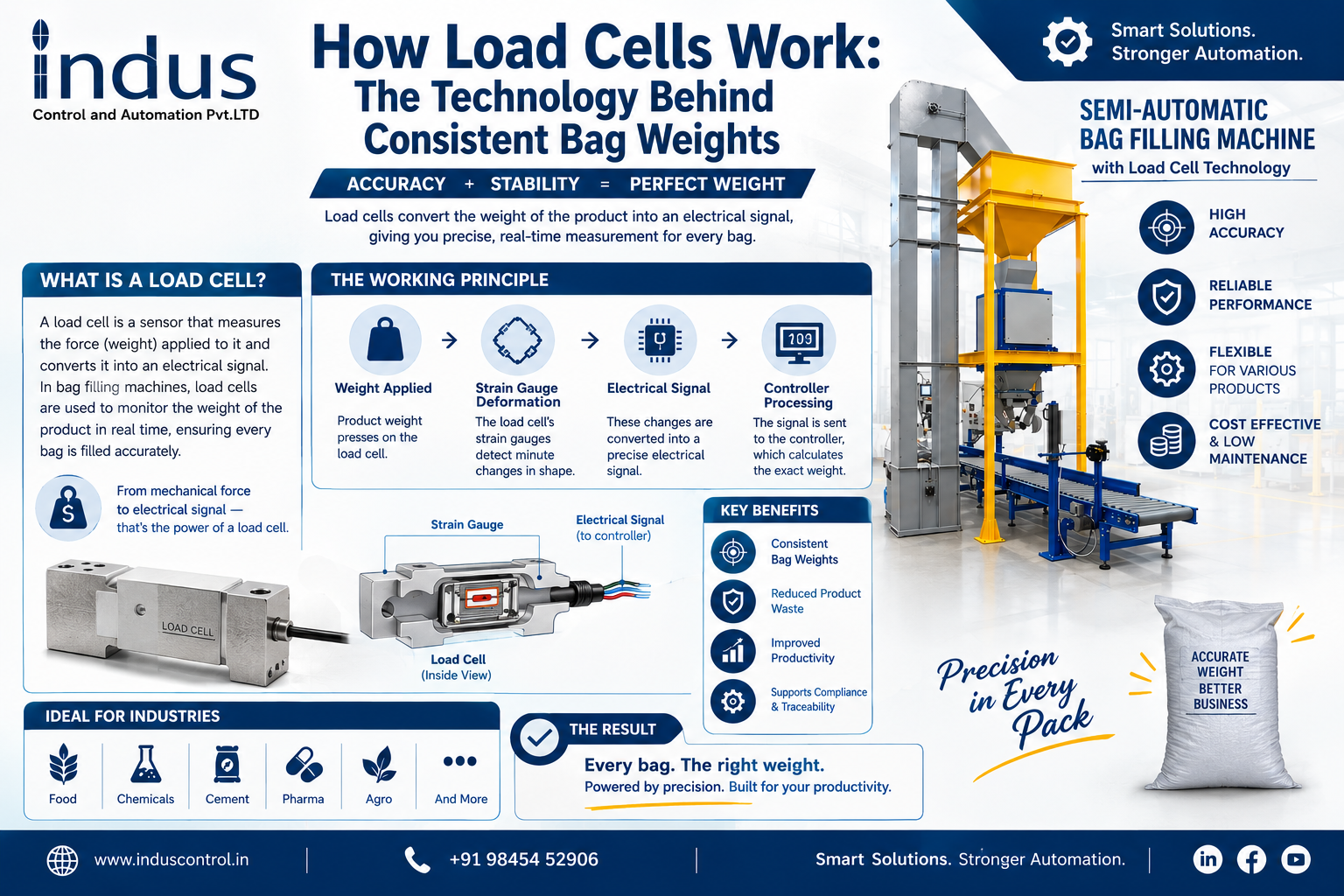
Every accuracy claim on a bag filling machine spec sheet starts with one part. That includes every ±20g, every ±0.5%, and every promise of steady fill weight. Most buyers never think about this part. It is the load cell. This small, plain piece of engineering sits under the hopper. It does more to decide whether your bags come out right than almost anything else on the machine.
Knowing how a load cell works is more than technical curiosity. It helps you judge a spec sheet instead of just reading it. You can see what must be true for an accuracy number to be real, rather than accepting it at face value. This guide covers the whole technology. You will learn how a load cell turns weight into a signal. You will see how that signal becomes a reading you can trust. Then you will see how the full system hits a target weight, bag after bag.
In this guide:
- What a load cell is
- The core technology: strain gauges
- The Wheatstone bridge circuit
- From raw signal to calibrated reading
- From weight reading to filled bag
- Types of load cells
- What decides load cell quality
- How load cells are protected and installed
- Why this matters when you compare machines
- FAQs
What a Load Cell Is
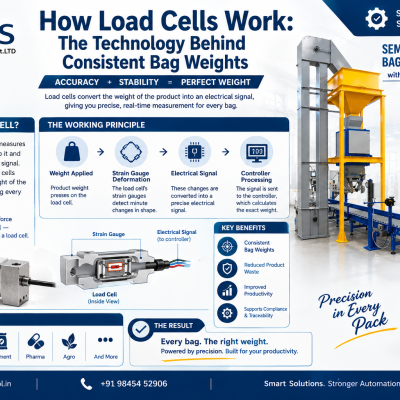
A load cell is a transducer. A transducer converts one form of energy or signal into another. A load cell turns a mechanical force, in this case weight, into an electrical signal. A controller can then read, process, and act on that signal.
Say a bag filling machine reports 24.98 kg in a 25 kg bag. That number began as a physical bend inside the load cell. The bend became an electrical signal. The signal then became a digital reading on the screen, all in the time it takes to glance at the display.
That chain forms the base of weighing accuracy. It runs from mechanical force to electrical signal to digital reading. Every other factor in accuracy talks, from calibration to stable surroundings, asks how well the chain holds up in real production.
Consider what load cells replaced. Before strain gauge load cells became standard, factories weighed with springs, levers, and counterweights. These parts turned force into a position that a person read off a dial. They worked, but they wore down and drifted as the metal tired. They also could not easily feed a reading into an automated control system. A load cell does the same basic job electronically and continuously. It gives a controller a fresh reading dozens of times per second. That shift to a live electronic signal makes automated, feedback-controlled bag filling possible.
The Core Technology: Strain Gauges
Almost every industrial load cell uses strain gauge technology, including those in bag filling machines. The idea is simple once you see it.
Inside the load cell sits a precisely machined metal element, usually aluminum or alloy steel. Engineers shape it to flex in a set, predictable way under weight. A strain gauge is bonded directly onto that metal. It is a thin, folded pattern of conductive foil or wire. When the metal stretches or compresses, the gauge does the same.
Here is the part that makes the system work. Stretching a thin conductor makes it slightly longer and thinner. That raises its electrical resistance. Compressing it does the opposite. The change is tiny, a fraction of a percent of the gauge’s total resistance even at full load. Still, it is real and consistent. It also grows in direct proportion to how much the metal bent, and that depends on the weight applied.
The whole physical principle comes down to three steps. Weight bends the metal. The bend changes the resistance. The system then measures that resistance change as its raw signal.
The Wheatstone Bridge: Making an Invisible Change Measurable
A resistance change of a fraction of a percent is too small to read directly. Electrical noise would bury it. The Wheatstone bridge circuit solves this problem, and engineers have built load cells this way for nearly a century.
A load cell usually does not use a single strain gauge. It wires four gauges into a diamond-shaped circuit called a Wheatstone bridge. Two gauges stretch under load, and two compress. This layout makes the circuit very sensitive to the difference between the gauges, not their absolute resistance. That cancels much of the electrical noise and temperature drift that would otherwise swamp the signal. A small, stable voltage runs across the bridge. The output is then a tiny voltage, typically a few millivolts per volt of input, that rises in direct proportion to the weight.
That millivolt-level output is what leaves the load cell. It is precise and proportional. No person could read it without the next stage of the system.
From Raw Signal to a Calibrated Reading
The millivolt signal travels to a digital weight indicator or HMI controller. The controller does three jobs in order: amplification, filtering, and calibration.
Amplification boosts the tiny signal to a level the controller’s analog-to-digital converter can handle accurately. Digital filtering then smooths out electrical noise and mechanical vibration. Without it, a passing forklift or a compressor switching on could show up as a false weight change. Calibration ties the whole system to a known reference. During setup, you load the machine with a certified reference weight. The controller learns which voltage matches which real weight. It then builds the conversion table that every later reading depends on.
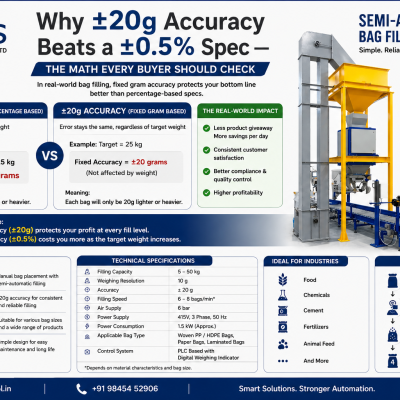
This is also where the gap between resolution and accuracy begins. We cover that gap in more depth in our guide on why ±20g accuracy beats a ±0.5% spec. Resolution describes how finely the controller can display its calibrated readings. Accuracy describes how close those readings are to the true weight. That depends on load cell quality, calibration precision, and how well filtering handles real-world noise. A controller can show readings to the gram and still measure poorly if the load cell or calibration falls short. For this reason, you should always judge the two numbers separately.
From a Weight Reading to a Filled Bag
A load cell that measures weight well only helps once the machine builds it into a control loop. The loop acts on each measurement in real time. This is where the engineering becomes specific to bag filling.
The Two-Stage Feed Sequence
Most bag filling machines use a two-stage feed, sometimes called coarse-and-fine or bulk-and-dribble feed. An empty bag moves into position and the cycle starts. The feed mechanism then opens fully and delivers product fast, often up to about 90–95% of the target weight. Meanwhile, the load cell reports the growing weight to the controller several times per second. As the reading nears the target, the controller tells the feed mechanism to switch from fast bulk delivery to a much slower, finer rate. The final portion of the fill then arrives gradually, not all at once.
Why the Slow-Down Matters
This switch matters a great deal for accuracy. A fast stream of product has momentum and lag. Product keeps falling and settling for a fraction of a second after the feed gate closes. This makes it unreliable to hit an exact target at full speed. A fine feed for the last few percent of the fill gives the system time to react to the live reading. The system can then cut off at just the right moment, before lag turns into a real error. The load cell does more than report a final number at the end of the cycle. It steers the fill second by second, from the first gram to the last.
This is how a ±20g accuracy figure comes about in practice. It does not come from one clean measurement. It comes from continuous load cell feedback that controls a feed mechanism, which slows down at exactly the right moment on every bag.
Types of Load Cells Used in Bag Filling Machines
Strain gauge technology is universal, but the mechanical design around it varies by use. A few configurations appear most often in bagging and weighing equipment:
- Compression load cells measure force pushing straight down onto the cell. They are common in platform-style setups, where the hopper or weigh bin sits directly on top.
- Shear beam load cells measure force as a shearing action through the beam. Builders widely use them in platform and hopper scales for their stability and their resistance to off-center loading. That helps when a hopper does not always load evenly.
- Single-point load cells keep their accuracy even when weight lands off-center on the platform. This matters when a bag or container does not sit in exactly the same spot each cycle.
- Canister and column load cells handle very high capacities. They fit bulk or jumbo-bag systems better than the 5–50 kg range of most semi-automatic machines.
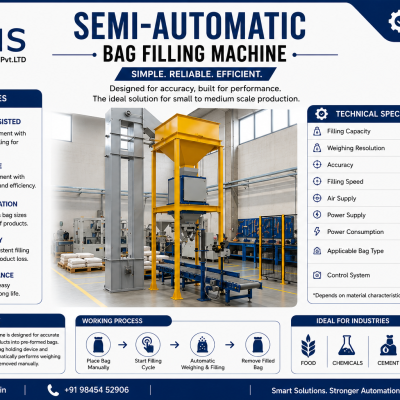
For a mid-scale semi-automatic bag filling machine, compression or shear-beam designs are the most common choice. Builders pick them for their balance of accuracy, toughness, and tolerance for the everyday knocks of an industrial floor.
What Decides Load Cell Quality
Two load cells can look the same and perform very differently day to day. A few properties separate a cell that holds its accuracy for years from one that drifts within months.
Material and Construction
The metal element under the strain gauges must flex in a precise, repeatable way, load cycle after load cycle. Lower-grade alloys or loose machining add small inconsistencies. Over time, these add up to real accuracy drift.
Temperature Compensation
Metal expands and shrinks with temperature. A poorly compensated load cell reports different weights for the same load just because the plant warmed up during a shift. Quality load cells build temperature compensation into the bridge circuit design.
Creep
Creep is the tendency of a reading to drift slowly under a steady load. A weight left on the cell should read the same at the start and the end of that period. A load cell with poor creep performance cannot quite manage this.
Hysteresis
Hysteresis describes whether a load cell reports the same weight when you add a load as when you remove and reapply it. In a well-built cell, loading and unloading the same weight should always settle on the same reading. The result should not depend on which direction the load came from.
Certification
Testing labs rate reputable load cells against international standards. OIML R60 is the standard for load cells, and the datasheet states an accuracy class. This ties directly to the certification and verification questions in our accuracy math guide. A maker who can name the OIML class of its load cells tells you something concrete about quality. A maker who cannot is asking you to trust a claim you cannot verify.
None of these properties appears in a simple accuracy figure on a spec sheet. That is why you should ask about them directly, not assume them from one headline number.
How Load Cells Are Protected and Installed
A high-quality load cell can still underperform if the installer mounts it poorly. Mounting and protection deserve as much attention as the component’s own rating.
Ingress Protection
Bag filling areas are dusty by nature, and many also see occasional washdown. Load cells here need a proper IP (Ingress Protection) rating to keep dust and moisture away from the sensing element and wiring. A cell rated for a clean, dry lab will not last the same way on a packaging floor, however accurate it is on paper.
Vibration Isolation
Motors, compressors, and nearby machines all send vibration through a plant floor. A load cell mounted without proper isolation will pick up some of that vibration as noise. Digital filtering can smooth out part of it. It cannot fully replace sound mechanical isolation at the mounting point.
Overload Protection
Every load cell has a maximum safe capacity. Most quality installations add mechanical overload stops. These stops keep an accidental impact or an overfilled hopper from damaging the sensing element. This risk is real on a busy production floor, where a load cell may take an unplanned knock.
Cable and Connection Quality
The signal from the load cell to the controller is only millivolts. Poor shielding, loose connections, or cable routed near noisy equipment can add error before the signal even reaches the amplifier. Buyers easily overlook this detail, yet it affects real-world accuracy.
Taken together, these details explain why two machines with identical load cell specs can perform differently. The component is only as good as the system around it.
Why This Matters When You Compare Machines
Understanding the technology changes what you ask when you compare quotations. It does so in a few concrete ways.
Accuracy and Resolution Are Different
Resolution describes the controller’s display step size. Accuracy depends on the load cell, the bridge circuit, calibration, and filtering working together. For that reason, you should ask for the two figures separately.
Conditions Matter as Much as the Component
Vibration, temperature swings, and dust are not cosmetic worries. They feed directly into the filtering and temperature-compensation systems described above. A load cell installed without proper isolation will not meet its rated specification, however good the part is.
Materials Affect More Than Hygiene
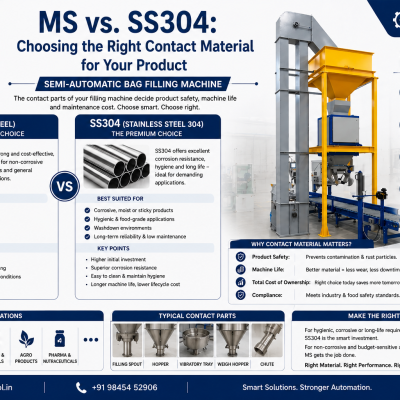
Our guide on choosing the right contact material for your product covers material choice. That material also shapes the load cell’s surroundings. Corrosion or contamination near the mounting point can cause exactly the measurement errors this system works to avoid.
Quality Drives Cost for Real Reasons
Load cell quality is a genuine cost driver, not an arbitrary markup. Material precision, temperature compensation, and certification testing are real engineering inputs. They also help separate a properly specified machine from one that is merely cheaper.
A buyer who understands this system asks sharper questions. Instead of just “What’s the accuracy?”, they ask which load cell type the machine uses and what certification it holds. They also ask how the cell is isolated from vibration and how often to recalibrate it. A manufacturer will find it much harder to answer these questions vaguely.
A bag filling machine’s accuracy is not magic. A manufacturer does not simply print it on a spec sheet. It comes from a specific, well-understood chain of engineering. A strain gauge bends under load. A Wheatstone bridge turns that bend into a measurable signal. A controller amplifies and filters the signal into a calibrated reading. Finally, a two-stage feed mechanism uses that reading, moment by moment, to know exactly when to stop.
Every link in that chain can hold up or fall short, and now you know what each one does. Indus Control and Automation builds its semi-automatic bag filling machines around this exact system. We use quality load cells, proper calibration, and a feed mechanism that relies on real-time weight feedback instead of a fixed timer. That is what a ±20g accuracy claim needs in order to be real. Want to see this system run on your own product? That is what a live demonstration is for.
Frequently Asked Questions
What is a load cell, in simple terms?
A load cell is a sensor that turns weight into an electrical signal. Inside it, a strain gauge bonded to a precisely engineered metal element changes its electrical resistance slightly when weight is applied. A controller reads that tiny, proportional change, amplifies it, and converts it into the weight on the machine’s screen.
How does a load cell achieve such precise accuracy?
Precision comes from three things working together. A well-engineered strain gauge bridge separates a true, proportional signal from electrical noise. Careful calibration against a known reference weight sets the scale. Digital filtering then removes vibration and interference. No single part does it alone. Accuracy comes from the whole chain, from the physical sensor to the software that processes its signal.
What’s the difference between a load cell’s accuracy and a machine’s overall accuracy?
A machine’s overall accuracy depends on more than the load cell. The feed mechanism must slow down precisely as the target weight nears. The controller’s calibration and filtering also count, as do vibration and temperature. A high-quality load cell is necessary for good accuracy, but it is not enough alone if the rest of the system does not match it.
Why do bag filling machines slow down near the end of a fill?
This is the coarse-to-fine (or bulk-to-dribble) feed sequence. The machine delivers most of the product quickly. It then switches to a slower feed for the final portion, so the load cell’s live reading can guide the exact cutoff point. Filling at full speed all the way to the target would overshoot again and again, because falling product keeps settling for a moment after the feed stops.
How often does a load cell need to be recalibrated?
No single interval fits every case. It depends on how hard you use the machine, the surroundings, and how much shock or overload the cell takes. Still, you should recalibrate against a certified reference weight on a regular schedule. Treat it as a standing maintenance item, not a one-time step at installation.
Can a load cell lose accuracy over time even without visible damage?
Yes. Creep (drift under steady load) and gradual wear from repeated load cycles can reduce real-world accuracy long before any damage shows. This is why periodic recalibration matters. It is also why asking about certification and build quality upfront beats assuming a machine will perform the same forever after it passes an initial accuracy test.
Does a more expensive load cell actually perform better, or is it just a certification badge?
A higher-grade, OIML-certified load cell reflects real engineering differences. It has tighter manufacturing tolerances, better temperature compensation, and lower creep and hysteresis. A certificate alone does not provide these. They decide whether a machine holds its rated accuracy over years of production or drifts within months.
Can poor installation ruin the accuracy of a good load cell?
Yes, and it happens more often than buyers expect. A quality load cell can perform noticeably worse than its rating if the installer skips proper vibration isolation, dust and moisture protection, or well-shielded wiring. Both the component and the installation must be right.