“What’s the price of a bag filling machine?” is the single most-searched question in this category — and it’s also the one question no honest manufacturer can answer with a single number. A bag filling machine price in India can vary enormously between two machines that look nearly identical on a spec sheet, because the price isn’t really set by the category of machine. It’s set by a dozen smaller decisions buried inside that spec sheet. This guide isn’t a price list, and you won’t find a number in it. Instead, it’s a breakdown of exactly what pushes a bag filling machine’s cost up or down, so that when you do request a quotation, you know precisely what you’re paying for — and whether the quote in front of you is actually comparable to the one sitting next to it. In this guide: Why There’s No Single “Bag Filling Machine Price” Search for a bag filling machine price in India and you’ll find wildly different figures across supplier listings — sometimes for machines that appear, on the surface, to do the same job. That spread isn’t manufacturers being inconsistent. It’s a reflection of how customized industrial packaging equipment actually is. Two “semi-automatic bag filling machines” can differ in weighing accuracy, construction material, controller sophistication, speed, and half a dozen optional accessories — any one of which can move the price meaningfully. A machine quoted for 5–10 kg cattle feed bags with a basic mild-steel frame and manual weight-setting is a fundamentally different product from a 50 kg-capacity, SS304, dust-controlled unit with a PC data-logging interface — even though both would technically list under the same product category. That’s precisely why a published “price list” for this category is nearly useless on its own. It answers a question (“what’s the cheapest one?”) that isn’t the question that actually matters (“what does my configuration cost?”). The rest of this guide is built to answer the second question — by walking through exactly what you’re paying for. The Core Cost Drivers Every quotation you receive is really a sum of the following decisions. Understanding each one is the fastest way to read a quote intelligently — and to make sure you’re comparing like with like. 1. Capacity Range and Weighing System The weight range a machine is built to handle — say, 5 kg to 50 kg versus a jumbo-bag system built for 500 kg to 1.5 tons — determines the size of the load cell, the structural frame, and the feed mechanism underneath it. A machine engineered for small retail-size bags is a mechanically simpler build than one engineered for bulk industrial bags, and the cost scales accordingly. Buyers sometimes over-specify capacity “just in case,” which quietly inflates cost for headroom they’ll never use — it’s worth sizing this to your actual production range, not your aspirational one. The width of the capacity range matters too, not just its upper limit. A machine built to hold accuracy consistently across a wide span — say, comfortably filling both 5 kg and 50 kg bags on the same unit — needs a more sophisticated load cell and calibration approach than one built for a narrow band around a single target weight. If your product mix genuinely spans a wide range, that flexibility is worth paying for; if you mostly run one or two bag sizes, a narrower, purpose-built range is usually the more cost-efficient choice. 2. Automation Level: Semi-Automatic vs. Fully-Automatic This is usually the single largest lever on price. A semi-automatic bag filling machine automates the weighing and filling while a person places and removes the bag; a fully-automatic system adds automated bag handling, magazine feeding, and often integrated sealing — each of which is its own mechanical and control subsystem layered on top of the same core weighing technology. We’ve broken this comparison down in detail in Semi-Automatic vs. Fully-Automatic Bag Filling Machines: Which Fits a Growing Line? — worth reading before you request quotes on both, since the automation level alone can shift the price far more than any other single factor on this list. 3. Weighing Accuracy and Load Cell Grade Not all load cells are equal, and accuracy isn’t free. A machine rated for tight tolerances — accuracy expressed in single-digit grams rather than a broad percentage of target weight — uses a higher-grade load cell, more sophisticated digital filtering, and more careful calibration during manufacturing. If your product is sold by declared weight under Legal Metrology rules, or your margins are sensitive to “giveaway” (the small overfill manufacturers add to avoid underweight bags), paying for tighter accuracy usually earns back its premium through reduced product giveaway over the life of the machine. 4. Construction Material: Mild Steel vs. SS304 Contact-part material is one of the more visible cost drivers, because it’s a straightforward raw-material difference. Mild steel (MS) construction costs less than SS304 stainless steel, which contains chromium and nickel and commands a real premium as raw material before it’s even fabricated. For non-food, non-corrosive materials — many chemicals, fertilizers, and construction materials — MS is often entirely appropriate and the more cost-effective choice. For food-grade applications, or products where hygiene and corrosion resistance matter, SS304 is usually worth the difference. The right answer depends on what you’re packing, not on defaulting to the more expensive option. It isn’t only the raw material that costs more, either. SS304 is generally slower and more specialized to weld and finish to a food-grade standard than mild steel, which adds fabrication time on top of the material premium. Some buyers split the difference sensibly — SS304 only on the parts that actually contact the product, with MS for the surrounding frame — which is worth asking a manufacturer whether they offer, since it’s rarely presented as an option unless you request it. 5. Speed and Throughput Requirements Bags-per-minute targets affect the feed mechanism, pneumatics, and controller response time. A machine built for a modest, steady output requires less engineering than
Semi-Automatic vs. Fully-Automatic Bag Filling Machines: Which Fits a Growing Line?
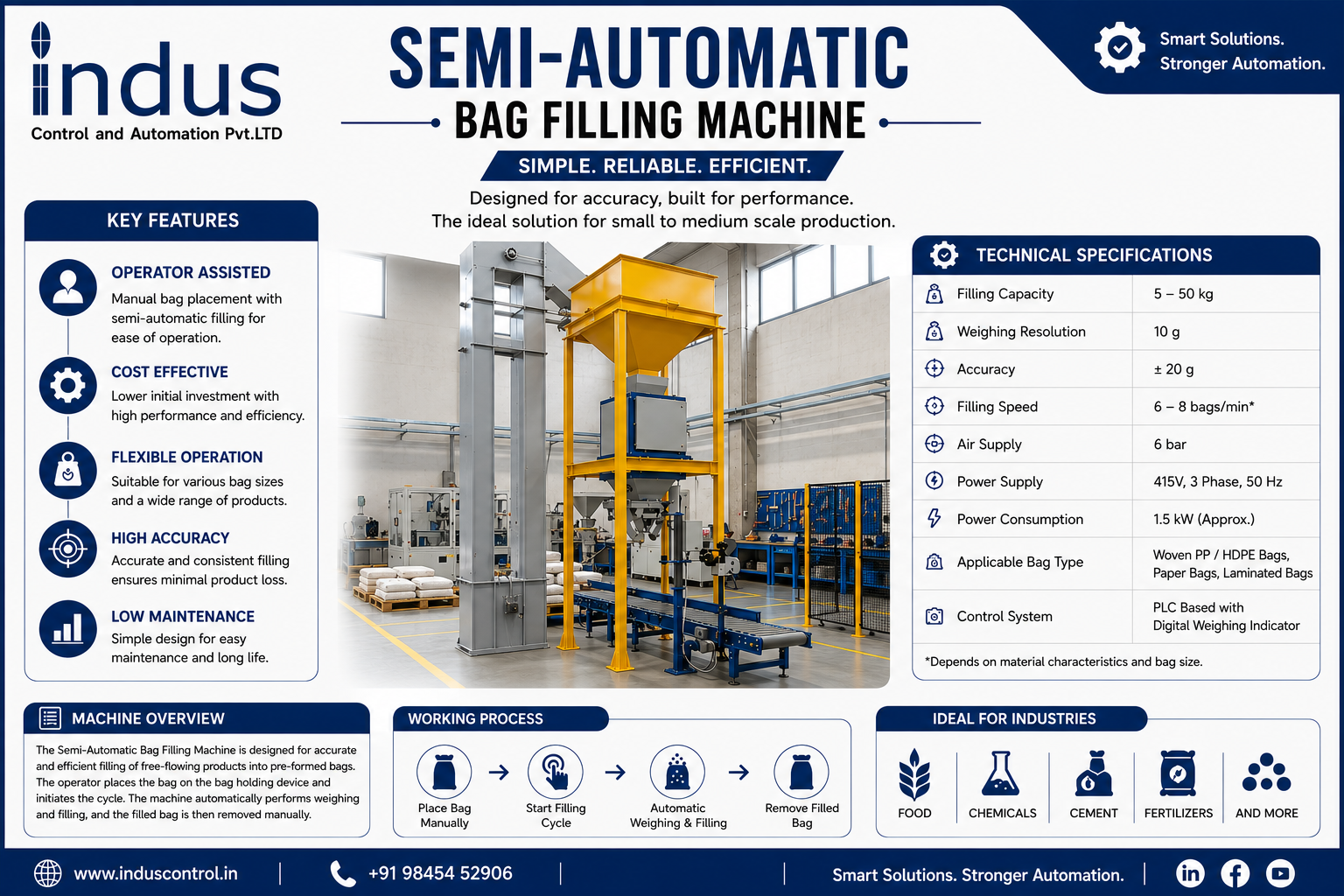
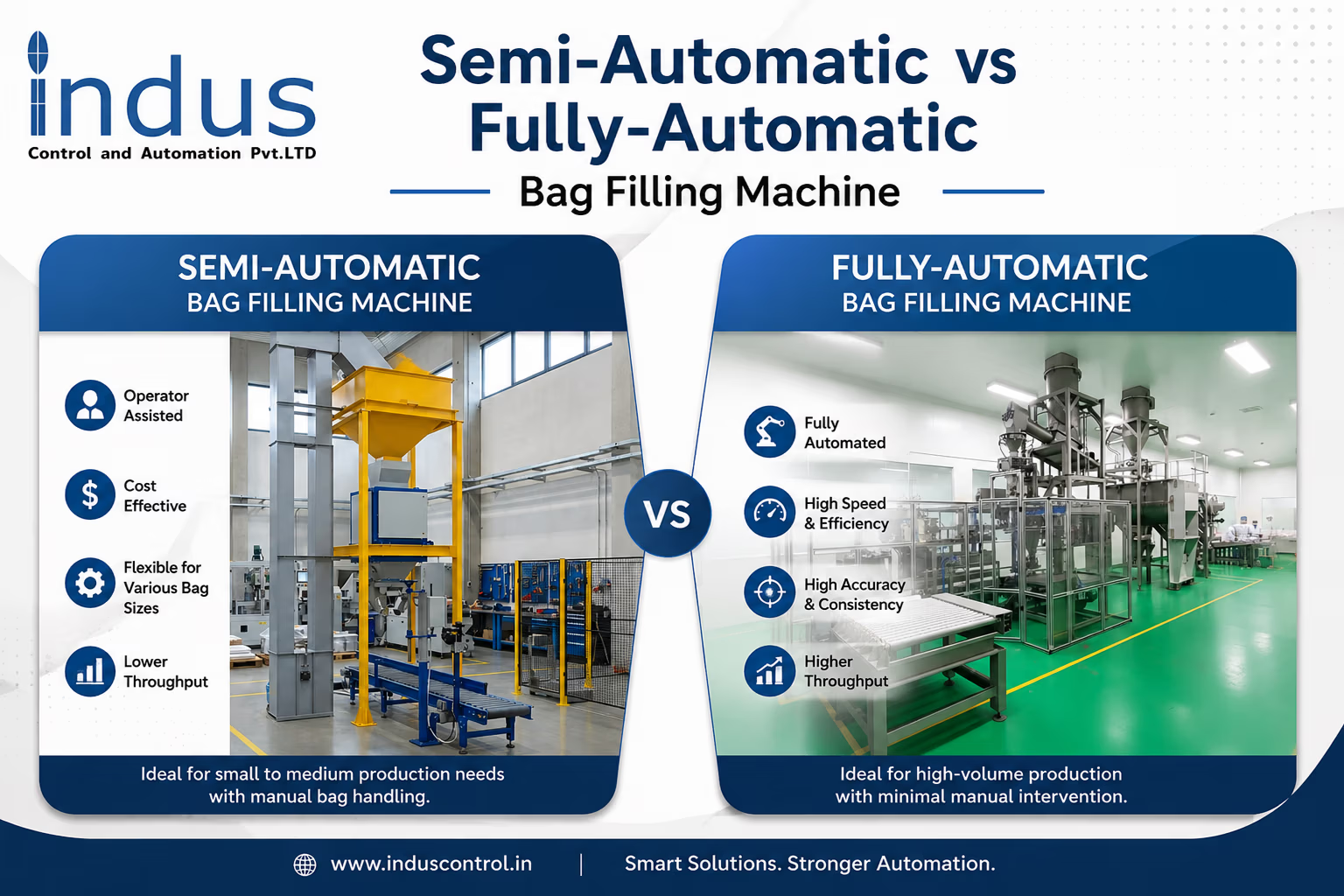
If you’re running a food grain, animal feed, chemical, fertilizer, or construction-material packaging line, you’ll eventually face the same decision: stay with a semi-automatic bag filling machine, or move up to a fully-automatic system. It’s one of the highest-impact equipment calls a growing operation makes, because it shapes your capital spend, your labor plan, and how much headroom you have for the next two to three years of growth. Neither option is universally “better.” A semi-automatic bag filling machine gives you precise, load-cell-based weighing while an operator still places and removes each bag. A fully-automatic system takes the operator almost entirely out of the loop, handling bag placement, filling, and sealing as one continuous sequence. Which one fits depends on your production volume, your budget, how many different products you pack, and how fast your line needs to scale. This guide walks through exactly where the two diverge — cost, speed, accuracy, flexibility, maintenance, and floor space — and which one actually makes sense for a business that’s scaling up rather than standing still. In this guide: What Is a Semi-Automatic Bag Filling Machine? A semi-automatic bag filling machine is a weighing-and-filling system that automates the part that’s hardest to get consistently right — the weighing — while leaving bag placement and removal to a human operator. The operator positions an empty bag on the filling spout, the machine’s load-cell weighing system dispenses a precise, pre-set quantity of material, and the operator removes the filled bag for stitching or heat sealing. That division of labor is the whole point. Weighing accuracy is where automation earns its keep, because a machine with a digital load cell and HMI controller repeats the same fill weight thousands of times without drifting. Bag handling, by contrast, is where flexibility matters most — a person can switch bag sizes, materials, or product types in minutes, something that’s far harder to automate cheaply. Typical semi-automatic machines in this class handle a 5 kg to 50 kg capacity range, with weighing accuracy around ±20 grams and resolution down to 10 grams, running at roughly 6 to 8 bags per minute. Controls are usually a digital weight indicator paired with an HMI touchscreen, and the machine itself is built from mild steel or SS304 for the parts that actually touch the product. That combination — strong accuracy, moderate speed, low operator skill requirement — is exactly why semi-automatic machines dominate the mid-scale packaging segment in India. What Is a Fully-Automatic Bag Filling Machine? A fully-automatic bag filling machine extends that same load-cell weighing system with automated bag handling on both ends. Empty bags are picked from a magazine or stack — sometimes with a robotic or pneumatic gripper — positioned under the filling spout automatically, filled, and then moved into an integrated stitching or sealing station without anyone touching the bag. The operator’s role shifts from doing the physical work to supervising it: loading bulk bag stacks, monitoring the HMI for faults, and handling exceptions. Because the whole cycle is mechanically timed rather than paced by a person, fully-automatic lines typically run faster — often somewhere in the 15 to 25+ bags per minute range depending on configuration, material, and bag size — and can run for longer stretches with fewer people on the floor. That speed and labor reduction comes at a cost: more actuators, more sensors, more integration points, and a bigger footprint. It’s the right investment when volume is high and consistent enough to justify it — which is exactly the trade-off the rest of this guide digs into. Semi-Automatic vs. Fully-Automatic: Quick Comparison Factor Semi-Automatic Bag Filling Machine Fully-Automatic Bag Filling Machine Typical capital investment Lower — a fraction of a fully automated line Higher — bag handling, robotics, and conveyors add significant cost Speed (indicative) ~6–8 bags/minute in the 5–50 kg range Often 15–25+ bags/minute depending on configuration Operators required 1–2 per station, placing and removing bags Minimal — mostly supervision and exception handling Best-fit production volume Low to mid-scale, seasonal, or multi-SKU High-volume, continuous, single or few SKUs Changeover flexibility High — manual adjustment for new bag sizes or products Lower — automated handling is often tuned to specific bag formats Floor space needed Compact Larger — bag magazines, conveyors, and control cabinets add up Maintenance complexity Lower — fewer automated subsystems to service Higher — more sensors, actuators, and integration points Typical buyer Growing SME, multi-product plant, seasonal demand Large-scale plant with steady, high-throughput demand The pattern is consistent across almost every dimension: semi-automatic trades some speed for flexibility and a lower entry cost, while fully-automatic trades capital and complexity for raw throughput and reduced headcount. Neither trade-off is wrong — it depends entirely on where your business sits today. The Real Differences, One at a Time The table above is a fair starting point, but the decision usually comes down to a handful of factors in more depth. Here’s what actually matters once you’re comparing real quotations. 1. Capital Investment and Total Cost of Ownership A semi-automatic bag filling machine is almost always the lower-risk first step. You’re paying for one precision subsystem — the weighing and filling unit — rather than an entire mechanized line. That matters most for businesses where cash flow, not throughput, is the binding constraint. Fully-automatic systems cost more upfront because you’re buying bag-handling automation, often a sealing or stitching integration, and sometimes conveyors or palletizing on top of the weighing core. The total cost of ownership calculation isn’t just the purchase price, either — it includes commissioning, operator training, spare parts inventory for more complex subsystems, and (usually) a service contract. None of that is a reason to avoid automation; it’s a reason to make sure the volume is actually there to justify it before signing. 2. Production Speed and Throughput Speed is the most obvious differentiator, but it’s worth being precise about what it actually buys you. At 6–8 bags per minute, a semi-automatic machine comfortably supports several hundred to a few